
The Five: Even They Couldn't Ruin These Olympics
Mikaela Shiffrin, George Orwell, and why patriotism is not nationalism.

This is Throwbacks, a newsletter by me, Michael Weinreb, about sports, history, culture, and politics—and how they all bleed together.
If you like what you read, please click the button below, join the mailing list for FREE and please share, on social media or through e-mail or however you feel comfortable sharing.
And if you’ve been reading for a while, please consider joining the list of paid subscribers to unlock paid posts and allow me to expand Throwbacks’ offerings.
Here’s a link to get 20 percent off a monthly membership for your first year:
And here’s link to get 25 percent off an annual membership:
(If you cannot afford a paid subscription and would like one, send me an email and I’ll comp you one, no questions asked.)
I.
The thing that I will always remember about living in New York City during a blizzard is how for the first 24 hours, everything goes quiet. The snow weighs down the trees and blocks out the noise; the cars and trucks are paralyzed, and the neighbors are arguing inside instead of out on the street, and what you are left with is this beautiful interlude where a city that is structurally incapable of shutting the hell up descends into a blissful silence.
And then after a day or so, it all starts up again. The garbage trucks rumble and the cars honk for no reason and the battle for parking spots resumes; the snow transforms from pristine white to slate gray to coal black, and you find yourself doing a half-gainer while sliding on the ice in an attempt to reach the bodega on the corner. But for a brief period, at least, you get to leave the worst of the city behind, and you get to live in peace and quiet.
II.
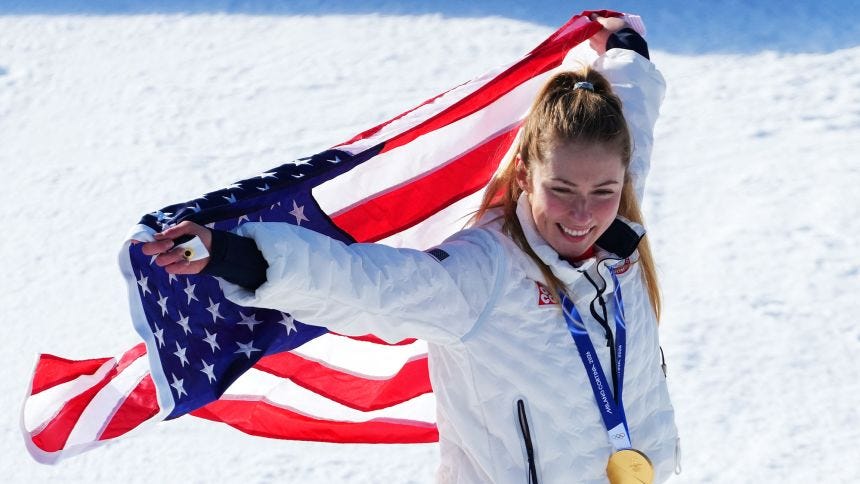
There was a moment last Thursday that was so quiet and meditative that it couldn’t help but break you down, even just a little. Mikaela Shiffrin, the 30-year-old considered to be the greatest slalom skier of her era, had fallen and failed to medal in eight straight Olympic races, partly due to the emotional weight of her father’s sudden death in a household accident in 2020. But now here she was, crossing the finish line in the giant slalom final a second-and-a-half ahead of her closest competitor. And when she got there, she stood alone and she appeared to mouth a word to herself, and then she collapsed to the ground and allowed the feeling to wash over her for several seconds.
On NBC, the excellent announcer Dan Hicks allowed the moment to breathe in silence1, and a few moments later, after the medal ceremony, Shiffrin conducted a post-race interview that became a kind of walking meditation on life and death and the purpose of it all.
We saw you release some emotions in the finish, the interviewer said. You turned around and took a minute for yourself. What were you releasing in that moment?
And here, under normal circumstances, is where the interview might have lapsed into cliche. But instead, the opposite happened.
Um, Shiffrin said. Honestly, like…
Long pause…
I mean, I was trying to talk to my dad.
III.
It is a strange bargain we make in consuming something like the Olympics. We find ourselves engaged with athletic pursuits we don’t fully understand, and getting to know athletes we otherwise have rarely or never heard of. And all of it is performed under the guise of national pride, which can prove especially uncomfortable at a moment in America when the majority of the country feels kind of embarrassed about the current state of the whole democratic experiment.

