
Oakland's Alysa Liu: A Brief Coda

This is Throwbacks, a newsletter by me, Michael Weinreb, about sports, history, culture, and politics—and how they all bleed together.
If you like what you read, please click the button below, join the mailing list for FREE and please share, on social media or through e-mail or however you feel comfortable sharing.
And if you’ve been reading for a while, please consider joining the list of paid subscribers to unlock paid posts and allow me to expand Throwbacks’ offerings.
Here’s a link to get 20 percent off a monthly membership for your first year:
And here’s link to get 25 percent off an annual membership:
(If you cannot afford a paid subscription and would like one, send me an email and I’ll comp you one, no questions asked.)

I.
There’s a restaurant down the hill from my house in Oakland, California that specializes in barbecue, latkes and cheesecake. None of it makes any sense, but it’s not really supposed to make any sense. It’s just a random assortment of foods that the owner, who appears to be a Jewish guy with a Cajun accent, adapted from his family recipes. And the thing about it is, this place is amazing. The latkes are great, and the barbecue is excellent, and the cheesecake is divine and comes in flavors like Hennessey praline. The other day, I tried his strange take on matzo ball soup, and that was good, too. It is weird and it is fantastic, and every time I go there I’m reminded that there are only a handful of cities like Oakland that can support such a bizarre alchemy.
I moved to Oakland nearly four years ago, and I’m only beginning to understand its complexities. This is a city of (literal) highs and lows, of hills and flats, of rich and poor, of function and dysfunction, of beauty and blight. It has deep-rooted problems—crime, homelessness—but it is also unbelievably diverse and surprisingly welcoming. I have had more random and cordial conversations on the street since I moved to Oakland than I did in 20 years of living in New York and San Francisco. I still love San Francisco for its stunning natural beauty, but there’s a kind of fraternal feel to Oakland, as if this is the place we all wound up in for varied reasons and we know it has its issues but we're also free to be ourselves here and to order a key lime cheesecake and a dinosaur rib and eat it next to Lake Merritt while watching an African drum circle.
All of this is a way of saying that I don’t think it’s an accident that Alysa Liu, who won the gold medal in women’s figure skating, identifies as an Oaklander. This may not be where she lives, but this is where she trains, and this is where she hangs out, and this is where she calls home, no matter what The San Francisco Chronicle might say:
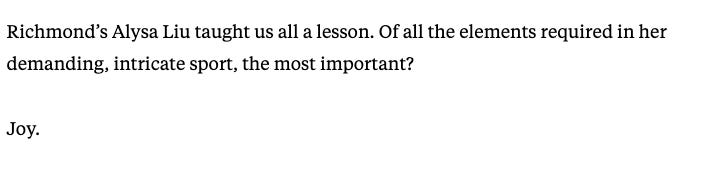
It is true that Liu’s family lives in Richmond, a small city north of Oakland. But it’s also true that she referred to her official hometown during the Olympics as Oakland, California; it’s true, as the astute Chronicle columnist Ann Killion notes later in that piece, that Liu has earned shout-outs from Oakland’s official mascot, Marshawn Lynch, and that after her short program on Thursday, she did not shout out Richmond or San Francisco but did shout out Oakland.
And why does this matter? It matters because Liu’s entire ethos is filtered through the lens of Oakland itself. This is a wonderfully weird place full of quirky and often very accepting people, and I imagine Liu gravitated to that for a reason. What happened with Liu is that she became a conventionally brilliant figure skater as a young teenager, and then when she was 16, she realized, This isn’t me. So she quit figure skating. She did other things until she found herself, and only then did she come back to figure skating.
“She has had to fight to reclaim (her) identity, to figure out what she likes—karaoke bars, video games, fashion, art, music, piercings, psychology,” wrote CNN’s Dana O’Neil, “so she could become who she is.”
II.
In an entire career covering and writing about sports, I’ve never seen an athlete who handles pressure quite the way Alysa Liu does. The closest analog might be Stephen Curry (whose formative years, perhaps not coincidentally, were also filtered through the lens of Oakland), or perhaps Joe Montana in the John Candy moment. Liu leaned into the pressure by refusing to even acknowledge its existence. Her ability to live entirely in the moment felt almost spiritual; she honestly didn’t seem interested in the results as much as the process itself. You kept waiting for the facade to crack, and for the smile to break, and for Liu’s ego to kick in, but it never did, because apparently this is who she really is now—a fully self-actualized human being at the age of 20.
Let us remember that Liu accomplished this in the world of figure skating—the world of little girls in pretty boxes and I, Tonya. Somehow, she completely shattered that stereotype in a matter of days. She managed to be hip and rebellious and to view that entire uptight world from the outside and realize just how debilitating it can be. She ate what she wanted and practiced how she wanted and chose the music she wanted. This is me, she said, over and over again. And if you happen like it, that’s fine, too. There aren’t a lot of athletes—let alone a figure skater—who make you realize that maybe you need to reset your entire approach to life, but I felt that a little bit with Liu, and I imagine there are a lot of young people who will feel it even more.
I don’t pretend to be some cultural expert on Oakland after living here for a few years, any more than Alysa Liu is. But I believe this is what certain American cities can do: They can help you find your true self amid the diversity. They can help shape who you are, even if who you are doesn’t conform to traditional ideals. It can happen in Brooklyn and Minneapolis and Portland and Austin and San Francisco; it can happen in a city where barbecues and latkes and cheesecakes exist peacefully, side by side. And maybe that’s why certain elements of power feel so threatened by these cities—because they allow young people like Alysa Liu, the daughter of a Chinese immigrant, to break free and to live free.
“She actually represents Oakland on the ice,” one former pro figure skater from Oakland told a reporter. “She’s a rebel. She just doesn’t fit into a box, and I love that about her…I feel like she could only have come out of Oakland — to have just such unapologetic power and joy. And even stepping back for a few years and then coming back also speaks to the resilience and grit.”

I have never seen a city take more abuse from people who have never set foot in it than Oakland; I have never seen a city blamed more for losing sports teams whose owners simply chose greed over civic pride. But none of that matters in this moment, because Alysa Liu proved that Oakland is still a city where things are possible, and she did it before her 21st birthday. She is Oakland’s Alysa Liu, now and forever.
This newsletter is a perpetual work in progress. Thoughts? Ideas for future editions? Respond to this newsletter, Contact me via twitter or at michaeliweinreb at gmail, or leave a comment below. If you enjoyed this newsletter, please join the list and/or share it with others.
Some of the best French fries I’ve ever eaten were made by a Syrian immigrant and a Lebanese immigrant at different restaurants in Evansville, Indiana, a city which is as Midwestern as you can get.
Beautiful. Just beautiful.