
You Got Mossed
How Randy Moss became a folk hero in an era where folk heroes were presumed dead.

This is Throwbacks, a newsletter by me, Michael Weinreb, about sports, history, culture, and politics—and how they all bleed together.
If you like what you read, please click the button below, join the mailing list for FREE. And if you’ve been reading for a while, please consider joining the list of paid subscribers to unlock paid posts and allow me to expand Throwbacks’ offerings, and please share it with one or two people you know.
Here’s a link to get 25 percent off an annual membership for a limited time:
(If you cannot afford a paid subscription and would like one, send me an email and I’ll comp you one, no questions asked.)
I.
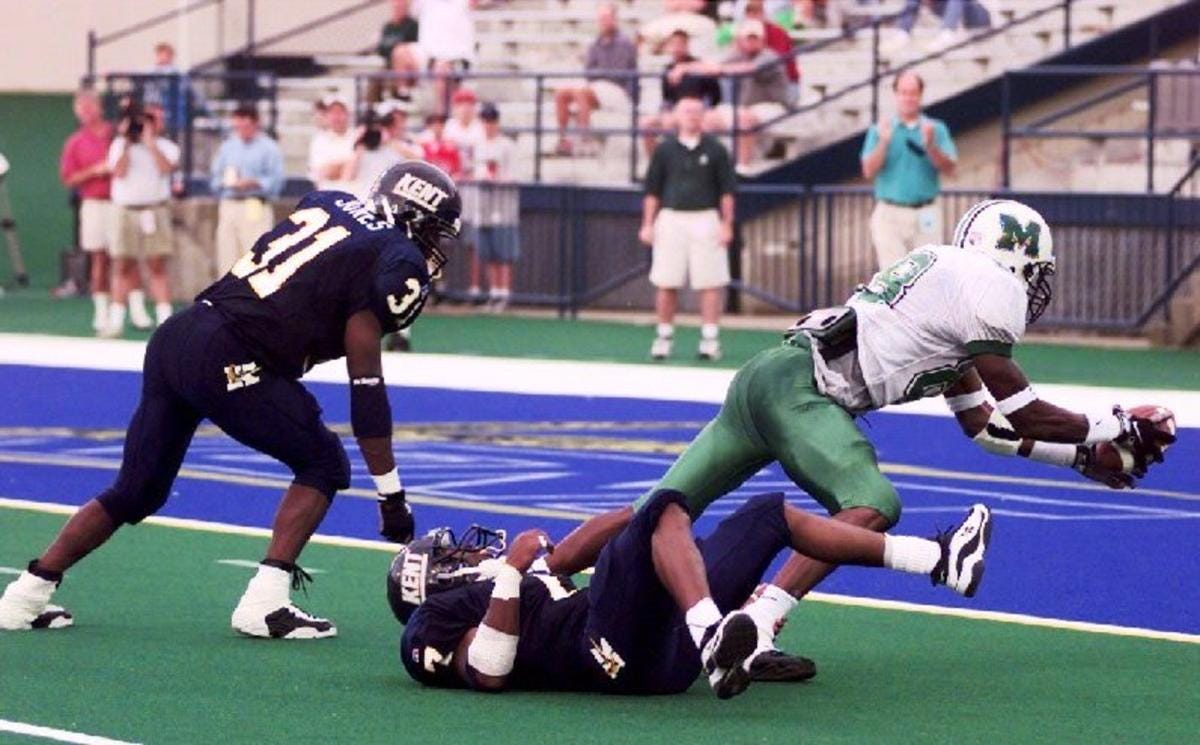
On a mid-September day in 1997, at a half-empty stadium in Kent, Ohio, Randy Moss caught eight passes for 216 yards and three touchdowns. I do not remember the specifics of any of those eight catches, or the details of any of those three touchdowns. I’m not sure if any of the highlights exist online, and I’d rather not watch them even if I could, because what I prefer to remember is the overarching feeling of what it was like to be there at all.
Every so often in life, if you’re lucky, you stumble onto the formation of a myth. You walk into a small rock club and catch a band that sounds like nothing you’ve ever heard before; you walk into a stadium or an arena and watch an athlete who completely blows your fucking mind. In a best-case scenario, the experience is not mediated or even recorded; it just unfolds organically, and the memory of it exists entirely inside your own head. It does not happen often, especially in these days when nearly every human experience is mediated, but when it does, there’s a sense of surreality to it, as if you’re stumbling through a kind of waking dream.
My friend and I drove twenty minutes from Akron to Kent because we had heard the growing buzz that Moss was a generational talent who had been relegated to playing for Marshall after getting thrown out of school at Florida State. We had seen the highlights on SportsCenter, but to actually bear witness to it in person in a small stadium with a crowd of roughly eleven thousand people was one of the wildest things I had ever witnessed in a lifetime of watching sports. What I remember is our dawning realization that something kind of insane was happening here. What I remember is getting to halftime and my friend and I becoming increasingly convinced that we would recall the outlines of this day for the rest of our lives.
There were still certain variables to be worked out; there was the lingering concern that Moss’s off-field problems might derail his professional football career. But the more you watched Moss play, the more you realized that he completely defied the angles of a football field, that he could literally do anything he wanted anytime he wanted, and that he did it all seemingly without exerting much effort at all. And at least in my lifetime, I could remember only one other athlete who exuded that nonchalant sense of inevitability—who understood that he was building a myth in real time.
II.
The most fascinating thing about Bo Jackson was his ability to manipulate his own image. Years ago, when I profiled Bo for ESPN, I could feel him bending me to his will, even as I was ostensibly the one interviewing him. He understood how people conflated reality and fantasy in their minds when it came to his football career; he recognized that he had become a real-life video-game avatar, and that this legend actually enabled him to separate his real life from the fantasy life. It made for a better story that way. It also made for an easier life for Bo, allowing him to maintain the air of an urban myth.
It didn’t even matter if all the stories about Bo were entirely true, because they felt true. He was the walking embodiment of that quote from the old Western film The Man Who Shot Liberty Valance: When the legend becomes fact, print the legend. And the quote I remember most from Bo—the one I still think about whenever I profile a celebrity athlete—is this one:
“I know how to feed guys like you with a long-handled spoon,” he told me. “I never let you get too close. I tell you what I want you to know, and I tell you what you want to hear.”
III.
There is a moment in Bruce Feldman’s excellent oral history of Randy Moss’s Pro Day that captures the sheer surreality of the Randy Moss Experience. A former Marshall offensive lineman named Jason Starkey recalls a day at practice when Moss broke toward the end-zone pylon, caught a pass over the head of a cornerback, tiptoed his feet in bounds, and then hid the ball behind his back so quickly and so deftly that the defender had no idea where the ball was. As the cornerback looked around, Moss produced the ball and flipped it to him.
“Getting ‘Mossed,” Starkey said. “I saw that at Marshall every day.”
I had not realized that “Getting Mossed” had so completely entered the lexicon until Chuck Klosterman mentioned in his book Football that his son was using the phrase on the playground, even though he had absolutely no idea who Randy Moss was. And that blew my mind all over again, because it made me realize that even amid the increasingly mediated culture of the 21st century, Randy Moss had managed to build himself into a living myth.

IV.
Feldman’s oral history is full of moments where the people around Moss watch him do things that don’t seem humanly possible. He lolls in the grass leading up to the final call for a 55-meter track race, then nonchalantly gets up and qualifies for nationals. He comes running into his Pro Day late after having car trouble and without warming up, vertical jumps 44 inches. He runs a 4.25 40 sprinting directly into a stiff wind while wearing a sweatsuit. It is a litany of stories that justify the meme, and it made me realize just how completely Randy Moss had lived up to every expectation he built for himself in those early years.
It doesn’t happen often, and every time it does, it is easy to wonder if it might not ever happen again. There was a sense, as I was writing and thinking about Bo Jackson, that someone like Bo might never come around again in a world where so much of human experience was documented on video. (I also happened to get to him at the right time, at a moment when he had largely faded from the collective memory and was living a quiet life in Chicago, before he became the subject of documentaries and fawning biographies.) But then along came Randy Moss. And Moss carried that same sense of mystery to him; he was an inscrutable figure who defied human limitations, and who did things both in public and on television that blew our minds, while also blowing people’s minds in those moments that were not captured by any cameras at all.
It is getting harder to believe that anything in the world can ever catch us by surprise when it’s all there on tape. But every so often, a myth slips through the cracks and satisfies our yearning for a great story. Every so often, even in our over-mediated world, the legend can still become fact.
This newsletter is a perpetual work in progress. Thoughts? Ideas for future editions? Respond to this newsletter, Contact me via twitter or at michaeliweinreb at gmail, or leave a comment below. If you enjoyed this newsletter, please join the list and/or share it with one or two people you know.
My personal examples of this are:
- Seeing Saquon Barkley hurdle that guy in the Buffalo game when Beaver Stadium was half-empty & in the midst of being trapped in a monsoon
- Finding Seattle-based rapper Macklemore's YouTube page years before he became famous.
Let's take a second to look at Randy Moss' absurd stat line from his 1998 Thanksgiving game at Dallas:
3 catches, 3 touchdowns, 163 yards.