
What Does Baseball Sacrifice When It Replaces Human Judgment?
A man called God, the automated strike zone, and what we lose when the umpire walks away.

This is Throwbacks, a newsletter by me, Michael Weinreb, about sports, history, culture, and politics—and how they all bleed together.
If you like what you read, please click the button below, join the mailing list for FREE. And if you’ve been reading for a while, please consider joining the list of paid subscribers to unlock paid posts and allow me to expand Throwbacks’ offerings, and please share it with one or two people you know.
Here’s a link to get 25 percent off an annual membership for a limited time:
(If you cannot afford a paid subscription and would like one, send me an email and I’ll comp you one, no questions asked.)
I.
Years before he became perhaps the greatest arbiter of balls and strikes in modern American history, Doug Harvey worked nine innings of a spring training game in Arizona. This was in the early 1960s, and Harvey didn’t have much money because he didn’t make much money, as umpires were so undervalued back then that they barely made a living wage. Harvey grew up the son of a baseball umpire and now he was a baseball umpire himself, and after working nine innings in the scalding Arizona sun, Harvey was approached by one of the team’s managers, who asked his crew if they could stay on for another three so they could get some more work in.
Harvey thought it over for a moment. He could live with the paltry wages, but he also didn’t believe his crew should work for free, so he proposed that they do it for twenty-five bucks a man. It wasn’t a fortune, but it wasn’t nothing, either, because if there was one thing Harvey understood, it was that his job required skill and dignity and authority that couldn’t be easily replaced1. Harvey brought his proposal to the manager, and the manager scoffed.
“Screw it,” he said. “We don’t need you.”
Ten minutes later, Harvey and his crew gathered their things and walked off the field. As they did, a melee broke out. The managers of each team had assigned a catcher to call balls and strikes, and a catcher on one team had made a call that the batter on the other team found egregious. They argued, the catcher threw off his mask, the batter punched him the face, and all hell broke loose. Harvey and his crew walked off, having proven their point. “The only thing standing between fairness and chaos,” he would say years later, “is the umpiring crew.”
II.
It is an odd time in American history to bear witness to the end of the singular authority of the baseball umpire behind home plate, but here we are. Tonight in San Francisco, when the Giants host the Yankees, a new era will commence: For the first time in a regular-season major league game, players will have the opportunity to challenge balls and strikes. It is, at least for now, a limited system called the A.B.S. (Automated Ball-Strike), where a batter, pitcher and catcher can challenge a call twice per game. If they win the challenge, they keep that challenge. If they miss twice, then they’re done.
This is a reasonable compromise, but it very well may also spell the beginning of the end for the human umpire, because we’ve borne witness over the past couple of years to the slow creep of technology into every element of our lives. A challenge system that evaluated calls beyond home plate was one thing, but the act of calling balls and strikes is such a fundamental element of a fundamentally American game that even Supreme Court justices evoke it as a metaphor. It means something more because it gets at the heart of a working democracy itself—the idea that we trust neutral arbiters to investigate and pass judgment and exercise a certain authority to maintain fairness in society.
But what happens when we cede that authority to the machines? And what happens when we do it now, at a moment when independent arbiters in nearly every field of American life are under constant attack? If baseball loses its soul, what happens to the country?
The thing about baseball is that it is not some purely logical exercise, as much as advanced statistics have pushed it in that direction. And the idea that baseball can ever become a purely logical exercise is a lie, because it is a game played by human beings. It comes down to judgment calls, just as Oliver Wendell Holmes argued in 1897, and just as every other human pursuit always will. At some point, we have to come to terms with our own fallibility, and accept it as part of the process.
Maybe the A.B.S. system will remain limited in its capacity, but maybe it won’t: Commissioner Rob Manfred, who has proven repeatedly capable of extracting any kind of humanity from baseball itself, called it a “first step.” And that second step is not something anyone wants right now, but increasingly, these changes arrive not because anyone demanded them; they arrive merely because the technology exists. The choice feels as if it’s out of our hands.

III.
There is another dramatic story Doug Harvey liked to tell about the early days of his major-league umpiring career:
In his third-ever game behind home plate, Stan Musial came to bat with the bases loaded and two outs in the bottom of the ninth. The pitch approached home plate, and Harvey raised his arm to call it a strike before it had even arrived. This is the way he’d been taught to umpire: Be quick! Be decisive! But then the pitch broke sharply. It landed in the catcher’s mitt three inches outside home plate. Musial didn’t even turn around to look at Harvey when he spoke.
“Young fellow,” he said, “I don’t know what league you came from, but we use the same plate. It’s 17 inches wide.”
That was the moment when Harvey learned to deliberate rather than anticipate. This was also when he began to realize that umpiring itself was a living, breathing process. Arguments, he believed, were part of the game, and as long as the discussions were civil and didn’t devolve into name-calling, he readily accepted them. Over the years, Harvey’s nickname became God, but there’s an obvious irony to it, because what made Harvey the greatest umpire of his era was that he didn’t view himself as a god. He viewed himself as a fallible human being who was doing his best to make the world a fairer place.
IV.
I imagine the ABS system will quickly become an accepted element of a Major League Baseball game, the same way it’s worked in tennis. But we’re at such a precarious moment here that I also think it’s worth weighing each of these changes carefully. The thing about umpires like Harvey is that they were able to project authority, even when they got something wrong. Their very presence kept the game from devolving into chaos. This is the purpose of the law and journalism and all those professions where the job is to speak truth to power.
“Can we just play baseball?” pitcher Max Scherzer once said. “We’re humans. Can we just be judged by humans?”
I guess the larger question we have to ask ourselves, once we emerge from this horrific period in American history, is whether we can rediscover enough trust in each other to once again cede that kind of authority to our fellow human beings. I don’t know what it will take to get there; I don’t know how you rebuild institutions once they’ve been torn down by bad actors that include the president of the United States. But it has to start somewhere, and maybe it starts with something as quietly courageous as continuing to trust human beings to call the vast majority of balls and strikes.
V.
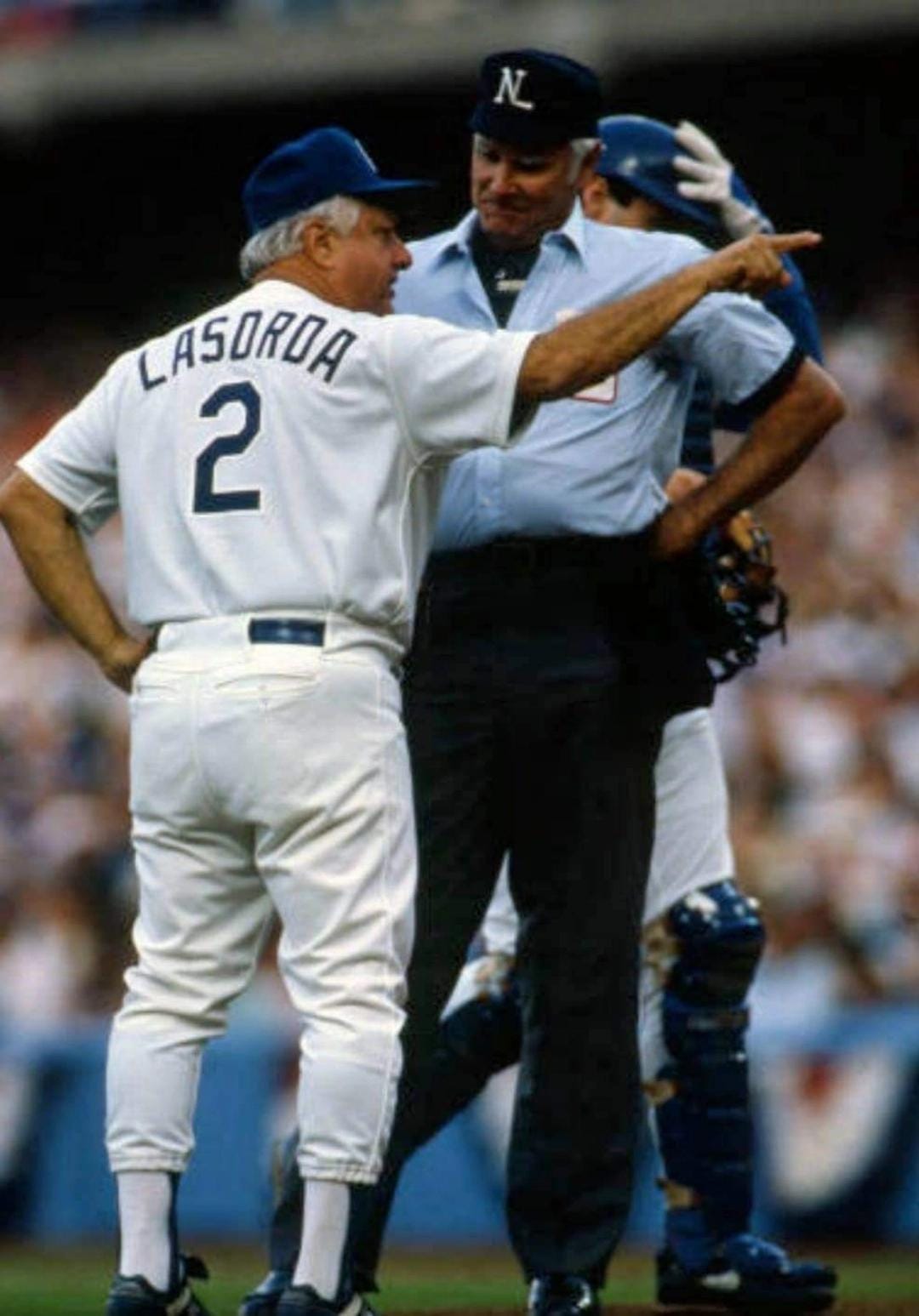
Years after he first visited Candlestick Park in San Francisco and proclaimed, I’m going to umpire in this stadium someday, and years after he taught himself the rulebook because he couldn’t afford umpiring school, and years after he worked games in the Class C California League for $250 a month, and years after he advocated for the rights of umpires to form a union and prove their own worth, Doug Harvey found himself getting berated by Tommy Lasorda. It was a Dodgers-Mets game in the 1980s, and Keith Hernandez was at the plate for New York with a count of two balls, no strikes. And amid the incessant complaints from the Dodgers’ dugout, Hernandez turned to Harvey and said, “Don’t let those guys intimidate you.”
“Nobody,” Harvey said, “has ever intimidated me, son.”
This newsletter is a perpetual work in progress. Thoughts? Ideas for future editions? Respond to this newsletter, Contact me via twitter or at michaeliweinreb at gmail, or leave a comment below. If you enjoyed this newsletter, please join the list and/or share it with one or two people you know.
“It’s like not having a police force in our society,” Harvey said in 1979, when baseball used replacement umpires while the real ones struck for more money. “The amateurs can’t cope because they don’t have our training.”
From the detail of Harvey’s experience to the larger metaphorical facet, this is as good as anything I’ve read this year. Sometimes everyone reaches to connect disparate realms of society in columns such as this one. But this doesn’t feel like a wild grasp at all. Beautifully done, Mike.
If it does not progress beyond this then the disruption should not be too great. However, replays in basketball and football have evolved to a point it makes watching a game a long tedious process. For the fans at the game, who already have to endure long TV timeouts, it is especially tiresome. So I agree the danger is there.