
The Artist and The Scoreboard
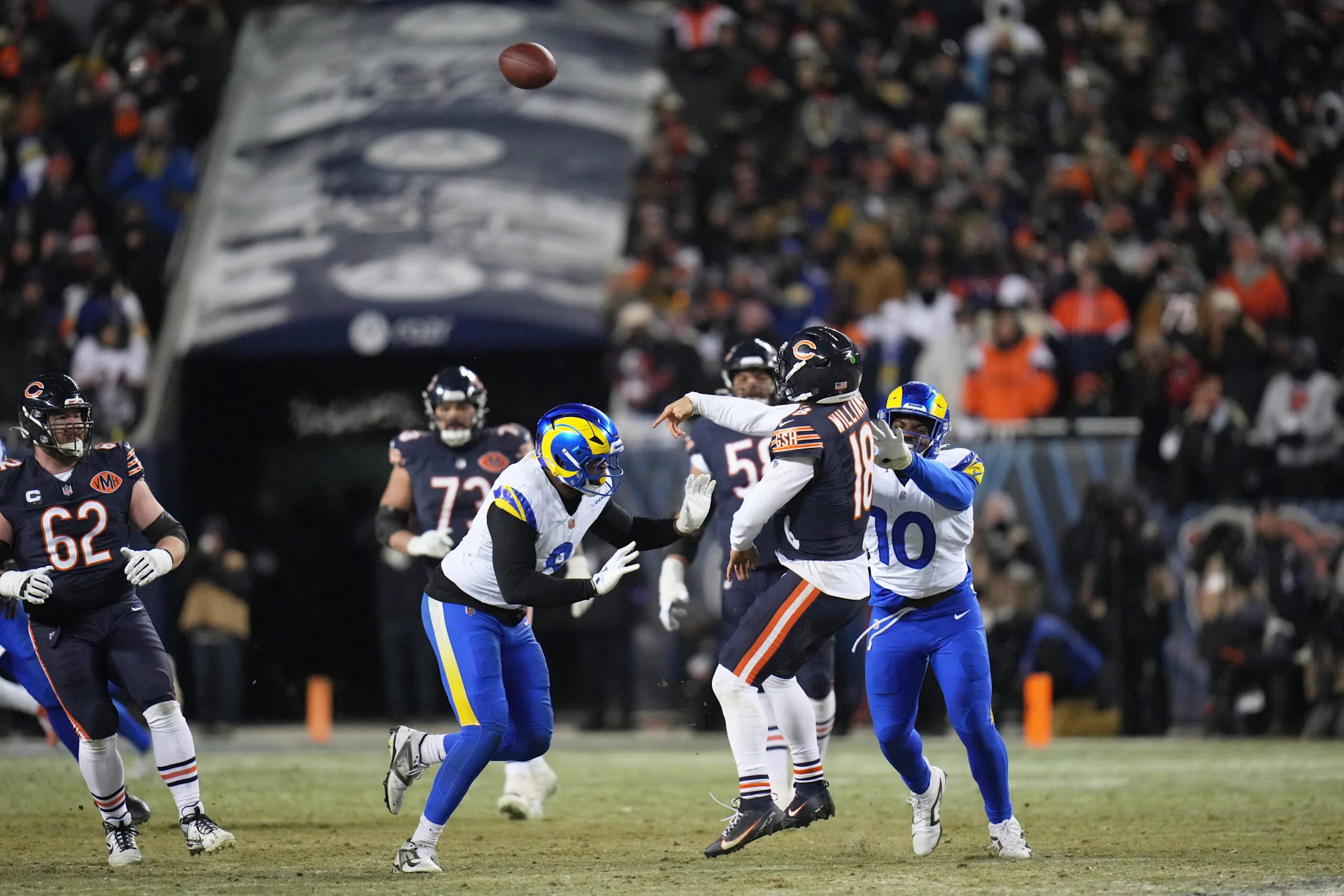
Caleb Williams made the throw of the year. His team lost. How much does it matter?

This is Throwbacks, a newsletter by me, Michael Weinreb, about sports, history, culture, and politics—and how they all bleed together.
If you like what you read, please click the button below, join the mailing list for FREE and please share, on social media or through e-mail or however you feel comfortable sharing.
And if you’ve been reading for a while, please consider joining the list of paid subscribers to unlock paid posts and allow me to expand Throwbacks’ offerings.
Here’s a link to get 20 percent off a monthly membership for your first year:
And here’s link to get 25 percent off an annual membership:
(If you cannot afford a paid subscription and would like one, send me an email and I’ll comp you one, no questions asked.)
I.
There is only one truly great account on the entirety of social media, and it is run by a guy named LJ Rader. The whole idea for it began with a magnificent obsession: Rader, who worked in the business of sports, would race through various museums, take copious pictures of the artwork, and assemble a catalogue, both on his phone and in his head. Then he would watch games of various kinds and find moments that correlated to the paintings he’d seen. He called it ArtButMakeItSports, and lo, the first and last glorious child of Twitter was born (and will soon become a book).
In a world where everything seems to be growing coarser and dumber, Rader chose to row against the tide. By equating American football in particular with the works of the European and American masters, Rader was furthering the work that NFL Films had begun decades earlier (it’s no wonder that NFL Films profiled him in 2024). He was attempting to reframe a sport marked by coarseness and brutality and zero-sum thinking as something that also bore the unmistakable beauty and kineticism of art itself. And honestly, no social media account has ever made me feel quite what I do when Rader gets one exactly right (as he almost always does). It makes me hopeful that sports have a greater purpose in life than just the end result.


II.
I know recency bias is almost impossible to escape in this oppressive cultural era, but I’m honestly not sure we’ve ever witnessed a better two-week stretch of football than what just unfolded before our eyes. On Monday night, Indiana struggled with a surprisingly feisty Miami team before winning the national championship, which is a sentence I mostly just typed so I could see what it felt like to type that sentence. Beyond that, the first two rounds of the NFL playoffs were perhaps the best we’ve ever seen, with nearly every game coming down to the fourth quarter,1 and several of them coming down to the last play.
And that brings me to perhaps the greatest piece of sports-driven artwork I’ve borne witness to in quite some time. It came at the end of regulation of the Bears-Rams game, one in which I had no personal stake, but which culminated in a play so stunningly improbable that it led me to shout out loud.
I mean, go ahead and watch this and tell me it’s not a work of a master:
