
Goodbye To All The Shouting
A eulogy for the Embrace Debate era, and (hopefully) for the culture it built.

This is Throwbacks, a newsletter by me, Michael Weinreb, about sports, history, culture, and politics—and how they all bleed together.
If you like what you read, please click the button below, join the mailing list for FREE. And if you’ve been reading for a while, please consider joining the list of paid subscribers to unlock weekly paid posts and allow me to expand Throwbacks’ offerings. And please share it with one or two people you know.
I.
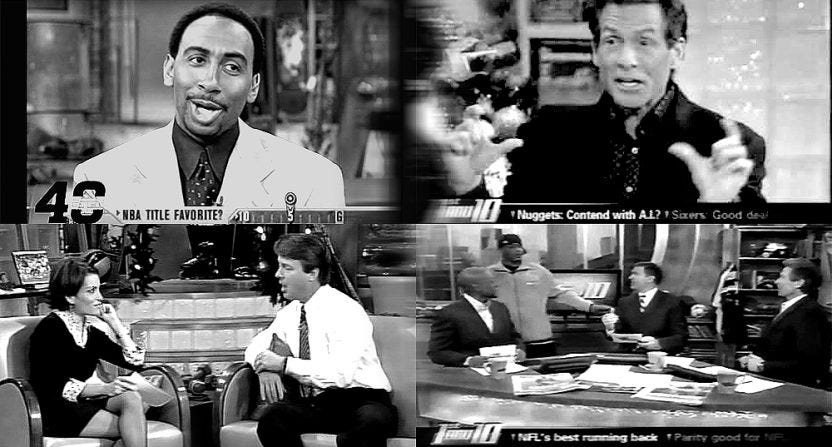
Before cacophony and chaos became the default state at ESPN, there was a morning show, and lo, they named it Cold Pizza, which was either the worst or the most apt possible name for what was essentially a warmed-over version of a stale idea. This was ESPN (ESPN2, to be precise) in the early-to-mid 2000s, back when ESPN was in the early stages of presuming that ESPN could no longer just be ESPN anymore, and after they’d begun to realize that Gen Xers were not merely going to be swept up in their wake by leather jackets and ee cummings fonts.
Cold Pizza debuted in the year 2003, and after a while, as Deadspin steadily tore it to pieces, ESPN began to realizing that this wasn’t really working, but what was working were the greasy hot takes contained inside of Cold Pizza. By 2007, Cold Pizza had been jettisoned into the dumpster of television history, to be supplanted by a show called First Take, in which debate was manufactured and processed for widespread consumption. From the beginning, ESPN’s ombudsman, Le Anne Schreiber—and yes, children, there was a time where ESPN was invested enough in the idea of journalism to hire an ombudsman—warned that this was a terrible idea, and that the shrill “absolutism” of the arguments made by men like Skip Bayless and Stephen A. Smith would eventually detract from the network’s journalistic reputation. (Let us use this juncture to note that Pardon the Interruption, a show also framed around debate, debuted in 2001, but was driven by an essential element that those other shows never had, an esoteric concept known as “authenticity”.)
“It is too late for ESPN to dial it back or dumb it down, too late to satisfy the savvy core audience it created with the thin gruel of sound bites, shouting heads and the celebrations of the obvious,” Schreiber wrote in her final column in 2009. “If it wants to sustain its success, ESPN has no choice but to keep getting smarter.”
We all know what happened next: ESPN pressed forward into its “Embrace Debate” era, and over the course of the next two decades, this became the primary thrust of ESPN’s studio programming, to the point that ESPN’s primary talking head, realizing his moment had arrived, has spent much of the past year-and-a-half feinting about a run for president. And I know it’s kind of a chicken-or-egg question, because it wasn’t like cheap and manufactured debate didn’t exist before ESPN built its studio shows around it (the year after Cold Pizza debuted, in 2004, Jon Stewart—if I may borrow the parlance of the modern aggregation website—EVISCERATED the hosts of Crossfire). But I wonder sometimes if it was ESPN that amplified the idea that the best way to attract attention was to manufacture the most radical opinions imaginable; I wonder if the Hot Take Era translated from ESPN to social media, and then became the default state of America itself.
II.
I imagine you are tired. I know I am tired. And part of the reason we are tired all the time these days is because what once felt like an exaggerated television format has become the dominant language of public life. The medium has evolved, of course, but the absolutism that Schreiber warned of—the thin gruel of sound bites and the shouting heads—is now so commonplace in our daily existence that we are too exhausted to spend much time contemplating just how ubiquitous it all is, and just how much it has poisoned the overarching discourse. And yet just when you think it might never end, a funny thing appears to be happening at ESPN, which is that they have realized that all of this manufactured bullshit just isn’t resonating the way it once did.
At a recent meeting of ESPN talent, a new executive named Mike Foss informed the room that rather than embracing debate, ESPN would now “embrace authenticity.” Foss brought with him “internal research showing ESPN’s brand of synthetic debate isn’t resonating with viewers the way it used to,” according to Awful Announcing, paraphrasing a report from Puck’s John Ourand. A few weeks earlier, ESPN laid off a pair of ex-NFL players, Ryan Clark and Cam Newton, who had been central players in the latest iteration of the network’s Debate Industrial Complex.
None of this stuff ever really felt authentic, but perhaps there’s something to be said for the idea that ESPN is now acknowledging that all that “debate” was kind of a playful little lie that ran its course. Maybe there’s something to be said for the fact that ESPN has reached a tipping point, because maybe it means we’ve all reached a tipping point. I hate to say it, because I’ve been wrong many times before, but maybe ESPN’s evolving approach reflects the earliest green shoots of a vibe shift, one that begins to spread outward from sports into the larger culture, one where we’ve finally grown so tired of being confronted with so much synthetic bullshit on a daily basis that the people in charge have finally begun to listen to our screams.
III.
It is not all glorious news, of course, given that ESPN appears to still be building its future around a series of bro-casts, including a signature show starring an abrasive ex-punter who continually offers a platform to an aging quarterback so desperately thirsty for attention that he continues to litigate the idiotic shit he said five years ago. But beyond that, there is a sense that maybe we’re starting to emerge from a decade-long slumber and realizing that we can do better than this. For years now, we’ve all known that things are getting worse, and we’ve felt helpless to do anything about it. But if ESPN is reacting to the feedback that things are getting worse, too, maybe other executives in other C-suites will take a cue from the network that, as Awful Announcing writes, “perfected the assembly line” for hot takes.
There are good people at ESPN who are trying to make it smarter, like Mina Kimes, who has mainstreamed football wonkishness for the masses; there are good people who left ESPN, like Pablo Torre, who are winning Pulitzer Prizes for repurposing journalistic curiosity into new and compelling visual formats. Even beyond that, there is a larger sense that the current cultural templates are beginning to wear thin. People are slowly becoming drawn to things that ask us to pay attention rather than immediately react, like the relative quiet of the movie theater, or the relative peace of the written word. The noise has become too much, and the stupidity has become so flagrant, and we’re all flailing about, searching for ports in the storm.
So maybe it’s my own naivete, but maybe, finally, nearly two decades after Le Anne Schreiber (R.I.P.) delivered a series of pointed warnings, ESPN is finally done feeding the machine and ready to start getting smarter again. And maybe the idea that synthetic debate is dead trickles outward from a sports network into the culture at large, and maybe we take one small step back into an era where absolutism gives way to authenticity.
This newsletter is a perpetual work in progress. Thoughts? Ideas for future editions? Respond to this newsletter, Contact me via twitter or at michaeliweinreb at gmail, or leave a comment below. If you enjoyed this newsletter, please join the list, consider becoming a paid subscriber, and/or share it with one or two people you know.
Sounds like you would make a spectacular ESPN ombudsman. Don't take it if offered. You'd have to onboard far too much garbage in order to land on one rare swell thing trying to find balance.
“I imagine you are tired. I know I am tired.” I am tired, Michael.