
Does Football Need Violence to be Football?
The rest of the world is co-opting our most essential sport...and leaving behind the one thing that might destroy it.

This is Throwbacks, a newsletter by me, Michael Weinreb, about sports, history, culture, and politics—and how they all bleed together.
If you like what you read, please click the button below, join the mailing list for FREE and please share, on social media or through e-mail or however you feel comfortable sharing.
And if you’ve been reading for a while, please consider joining the list of paid subscribers to unlock paid posts and allow me to expand Throwbacks’ offerings.
Here’s a link to get 20 percent off a monthly membership for your first year:
And here’s link to get 25 percent off an annual membership:
(If you cannot afford a paid subscription and would like one, send me an email and I’ll comp you one, no questions asked.)
i.
Before we begin today:
I had a great time talking to the travel writer and essayist Rolf Potts about Chuck Klosterman’s book Football. The book, and that conversation, are at least part of what inspired what you’re about to read, but if you want to listen to the podcast, you can find it here.
I.
Before there was football, there was violence disguised as football. At Harvard, they called it “Bloody Monday,” a melee between the freshman and sophomore classes that was outlawed by the faculty in 1860; at Yale, they sang couplets about tearing shirts and britches and ripping stitches. The game, such as it was, involved the advancement of an inflated pig bladder toward some kind of goal. Beyond that, wrote historian Allison Danzig, the game largely consisted of “kicking, pushing, slugging and getting angry.”
Eighty years later, in the midst of World War II, the soldiers at Fort Meade in Maryland were looking for a way to play football without tearing their bodies to pieces. And so they came up with a version of football that was designed to preserve their bodies for the actual fight. They called it “Touch and Tail.” Eventually, a couple of teachers in Arizona invented belts to wear around the waist with long dangling segments of fabric, and flag football was born.
And look, I know what you’re thinking: There is something about flag football that still feels, to a lot of Americans, like something less than actual football. But on the eve of the 60th Super Bowl, flag football is now arguably the biggest sports story that most people this country aren’t really paying attention to at all. And maybe that says more about us than we realize.
II.
Earlier this week, I crossed the bridge into San Francisco, descended the stairs of a downtown convention center, entered a room the size of the airplane hangar, and watched a group of preteens play flag football. The NFL was billing this as its first international youth championship, and the finals came down to Japan and Panama, two countries where American football is not exactly a mainstream pastime. All around me, gathered in the stands, were groups of young people from countries that have long cared far more about futbol than football. Panama’s quarterback was a fleet and elusive girl named Jimena Castillo; Japan’s team was full of versatile athletes who seemed to spring from every angle. The rules felt kind of obtuse, and the lack of blocking felt kind of disconcerting, but with only five people on a side on any given play, the action was wildly kinetic.
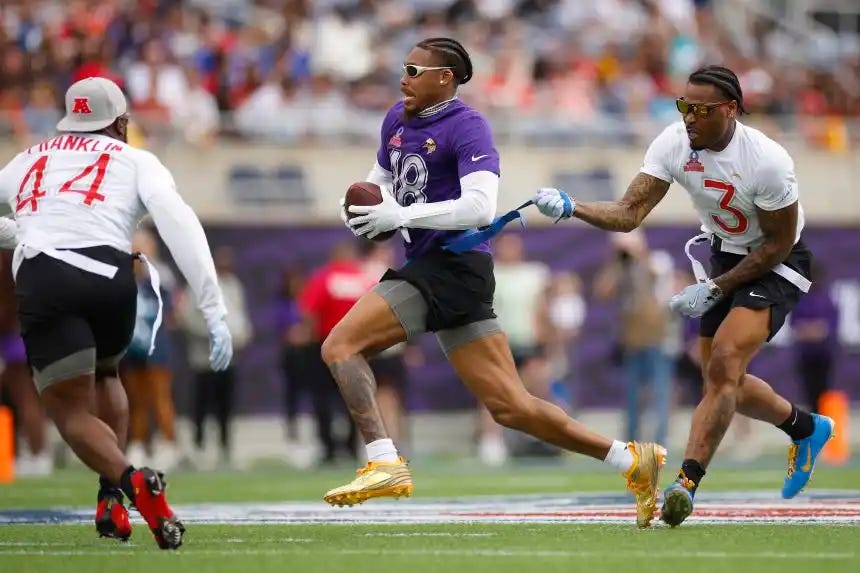
This game was a prelude to the Pro Bowl, which was held later that night inside the same room, but the vibe was entirely different. Watching NFL players saunter their way through a flag football game felt like the kind of thing that the current president of the United States would dismiss as an example of the sissification of professional football itself. But watching young people from faraway countries play the same game felt entirely natural. It was as if the American game and the international game existed on two separate planes, and it made me wonder if perhaps the rest of the world was developing the kind of newfound perception about football that Americans never would.
III.
Maybe if you have children, you already know this, but flag football is growing like crazy, in large part because many of its youth leagues have been sanctioned by the NFL. In 2028, it will become an Olympic sport, which feels like it will become yet another tipping point for a sport that has long been dismissed as something less than an actual sport.
And maybe—as the writer Anne Helen Petersen did—you can dismiss this growth as part of the NFL’s cynical attempt to “sportswash” the violence inherent in its own sport, to make tackle football more palatable by creating a sanitized alternative. But you cannot ignore the fact that something is happening here. There are now over two million kids playing flag football in the United States, and millions more playing worldwide. It is kind of an antidote to full-contact football, in that it’s an inclusive sport that requires little to no equipment and offers very little in the way of violence. It also cuts against all the iconography and mythology that defines American football as we know it, which is why a lot of America won’t give up youth tackle football without a fight.
When the NFL passes some new rule to regulate contact, the skeptics immediately grouse that the sport is “turning into flag football.” Flag football became a shorthand for the emasculation of the American male, in large part because football’s founding myth was that American males needed violence in order to avoid becoming emasculated. And yet, do the vast majority of people watch football because of the violence? I don’t think so. I think most people watch football, as Chuck Klosterman writes in his book, because the inherent threat of violence heightens the stakes. I think we demand the specter of violence because this is what we’ve always known; because this is what we grew up with; because this is how we’ve been conditioned to watch the sport. Football is war, and flag football is what you do when you’re conserving your body for an actual war.
But what if someone grew up with none of that conditioning? What if they were, say, a young girl from Panama whose only experience with the sport was flag football? Would the lack of violence matter to them at all, or would it just feel unnecessary? Is the rest of the world simply taking the best of our sport and leaving behind the worst of it?
IV.
“Violence is a part of America’s culture,” proclaimed Black Panther H. Rap Brown in the 1960s. “It is as American as cherry pie.”
There are a variety of theories as to why this is the case, but no one disputes the general premise. America is a violent country, and its most popular pastime is a violent sport. You cannot extricate those things.
That’s part of what makes the rise of flag football—and the NFL’s promotion of flag football—so fascinating. Because football still works without the violence, but only if you’ve been taught that the violence isn’t what makes it matter. To watch people run and throw and catch and defend is the central reason why the sport exists, and all of these exist in flag football, and I imagine that’s why it’s taking off across the world. But in America, it will always feel like something less than than the real thing.
In that way, I guess we are an exceptional country. It feels kind of wild to realize that the rest of the world has imported one of our most essential products and managed to strip away the one thing that jeopardizes the future of it. If someone suffers a catastrophic injury in Sunday’s Super Bowl, NBC will send us to a multi-million commercial break, and then likely come back as if nothing happened at all. But is that a sign that the rest of the world is fundamentally misunderstanding football? Or is it a sign that we’re the ones who are falling behind?
This newsletter is a perpetual work in progress. Thoughts? Ideas for future editions? Respond to this newsletter, Contact me via twitter or at michaeliweinreb at gmail, or leave a comment below. If you enjoyed this newsletter, please join the list and/or share it with others.
The Violence, trench warfare, run blocking , tackle breaking makes it compelling for me. Its my only sport and every offseason I watch (and share) recorded games from a massive archive. The Xs and Os and evolution make it esp fascinating.
Males are wired for kinetic spectacle. YT channels devoted to blowing stuff up, shooting things and seeing impact in slow motion. Some females too but it feels like 90% of males enjoy kinetic action, fights and fight scenes. Football is better with its teamwork, tactics, beautiful catches and amazing throws, beautifully synchronized run blocking and or pass rush then just plain old combat sport 2 men beating eachother.
For NFL to grow globally it needs to be the kinetic alternative to the real global game, soccer. You're never going to outcompete soccer for speed, agility with flag football. You bring this violently exciting chess match now you're talking.
And no equipment tackle is exhilarating to play as a boy. Its just more fun! Its a pain in the ass needing 22 kids and a grass field. 2 hand touch can be played anywhere and STILL, we did all we could to set up tackle games. Tore up the grass in all parks every fall-winter.
FWIW the NFL originally pitched tackle football for the Olympics, but the IOC opted for the flag variant.