
Who's In Charge Here?
Is it time to rethink what a manager or coach (or president) actually looks like?

This is Throwbacks, a newsletter by me, Michael Weinreb, about sports, history, culture, and politics—and how they all bleed together.
If you like what you read, please click the button below, join the mailing list for FREE. And if you’ve been reading for a while, please consider joining the list of paid subscribers to unlock paid posts and allow me to expand Throwbacks’ offerings, and please share it with one or two people you know.
(If you cannot afford a paid subscription and would like one, send me an email and I’ll comp you one, no questions asked.)
I.
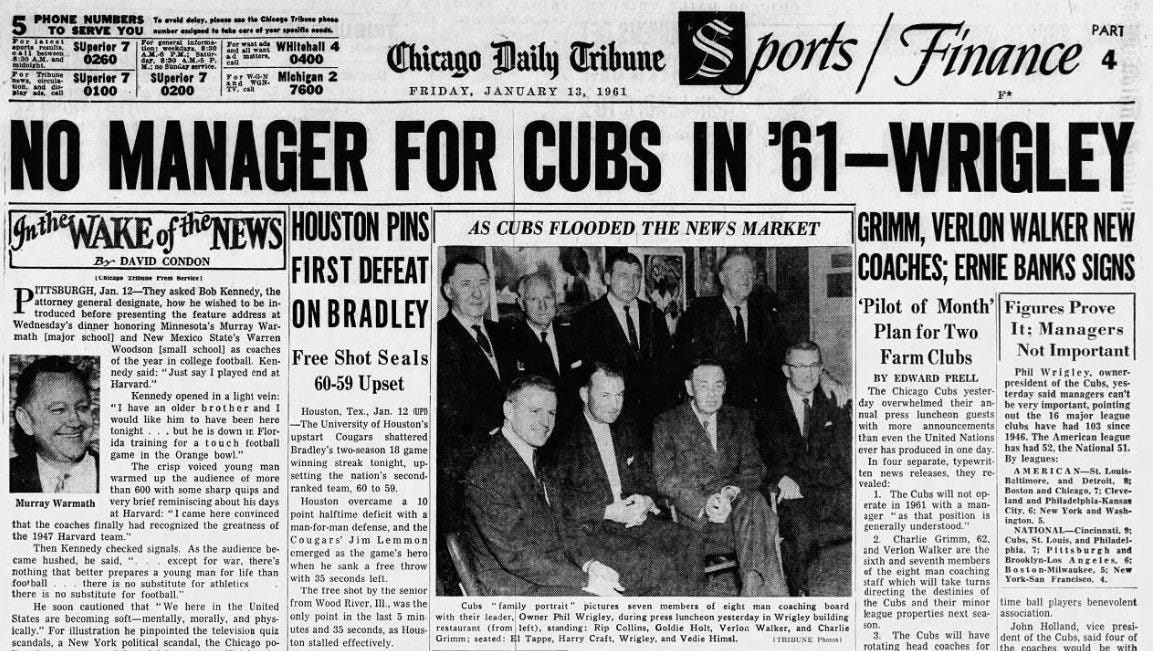
The disruption began on a January afternoon in 1961, when Philip Wrigley, the owner of the Cubs, ushered the press into a cramped restaurant in downtown Chicago and announced that he was going to rewrite the rules of baseball. Wrigley was flanked by a small group of middle-aged men, as well as many of his own players; the place was so crowded that Ernie Banks had to skip over the thick cords running from television cameras. It was a chaotic scene befitting the debut of a wild idea, and Wrigley admitted as much by holding up a sign that acknowledged the absurdity:
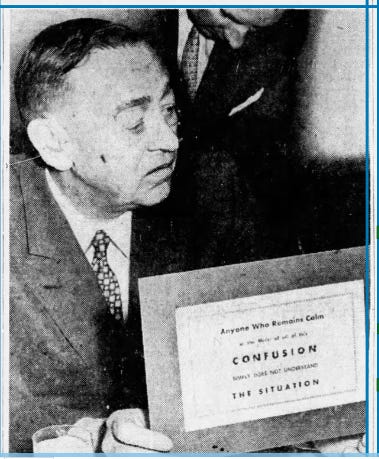
With that, Wrigley announced that the Chicago Cubs would not have a manager for the 1961 season. Instead, the Cubs would have eight managers, a rotating cast of characters that the press would soon sarcastically refer to as a college of coaches. “Now, about the word manager,” Wrigley told the assembled reporters on that January day. “I looked it up and the pure definition is ‘dictator.’”
Never mind that when Chicago Tribune reporter Edward Prell looked up the word in Webster’s later that day, he could find no evidence of the word “dictator” at all. This was a Germans bombing Pearl Harbor moment for Wrigley, and he was going to keep rolling. The Cubs hadn’t finished above .500 in 14 straight years, and over that time, 103 managers in baseball had been hired and fired, including seven with the Cubs. Something had to be done. Baseball was growing and expanding, just like corporate America was changing rapidly. Within his own chewing-gum company, Wrigley admitted, he’d already fired himself twice. What if the job of manager had grown to become too big for just one man? What if baseball utopia could be found in a rotating cast of characters who would never generate enough friction to get themselves fired?
Soon, the Cubs would issue a 21-page booklet to reporters with a banger title: The Basic Thinking That Led to the New Baseball Set-Up of the Chicago National League Ball Club. The notion was based on the idea of increased specialization leading to more specialized instruction, which would (at least ideally) lead to faster talent development. After expansion, Wrigley posited, the pool of major-league players would grow from 400 to 500, and talent needed to be developed more quickly and efficiently than ever, and this roving college of coaches was an attempt to “speed our farm products to the Cubs.”
If you squint, you can kind of see the logic there. Wrigley wasn’t an idiot; he’d also become one of the first owners to employ a team psychologist, and to use IBM computers for statistical analysis. But mostly, what you see in that moment is an owner who was tired of losing, who understood that the world was changing and that maybe the larger idea of leadership needed to change with it, and who was willing to experiment to find the right solution.
It was, of course, entirely the wrong solution. The players were mostly confused, and the coaches offered clashing ideas that made things even worse. Instead of pondering what kind of authority figure might actually work for the Cubs, Wrigley chose to cleave that authority into a variety pack. Baseball managers, it turns out, cannot be shuffled like Juicy Fruit and Doublemint; even John F. Kennedy made fun of the idea. The Cubs lost 90 games in 1961, and lost 103 in 1962 before Wrigley pulled the plug.
“The goal,” Wrigley said, “was not attained.”
II.
In our mind, we have an idea of what a coach (or a manager) looks like. We can see them in our heads. We have a sense of who they are and where they come from (some might call it “central casting”), and when somebody messes with that template, it messes with our head. It’s been happening more often lately, which makes me wonder if we’ve reached a point where our systems have become so utterly disrupted (and corrupted) that the people in charge have started to challenge their own assumptions.
This week, North Carolina, one of the most prestigious college basketball programs in America, announced that it would not delve into the college ranks for its next coach (though it does appear that they tried). Instead, North Carolina would hire a veteran NBA coach, Michael Malone, to take over the program, just as they’d hired a veteran NFL coach, Bill Belichick, to take over their football program. In a way, it makes sense: As college sports have converged so rapidly with professional sports, why not at least attempt to get ahead of the curve, both off the court and on it?
There’s always the possibility that out of a sense of desperation, North Carolina has merely embraced a terrible idea. But it’s also possible that the terrible idea is the one we’ve been carrying in our heads all along.
III.
Out here in the Bay Area, a former San Francisco Giants pitcher named Mike LaCoss recently called into a local sports-talk radio show to complain about his former team. A few months earlier, the Giants had become the first Major League franchise ever to hire a college baseball coach with no professional experience to manage their team. And to LaCoss, the hiring of that man, Tony Vitello, was an insult in itself.
“Don’t you think that’s kind of a slap in the face to all of the minor league managers in professional baseball and all of the bench coaches in Major League Baseball that think about becoming a major league manager?” LaCoss said. “They just bypassed all those guys and threw this college guy in there.”
