
When Did Quarterbacks Become Too Perfect? (1987)
How the NFL systematized brilliance--and what it means for the rest of us.

This is Throwbacks, a newsletter by me, Michael Weinreb, about sports, history, culture, and politics—and how they all bleed together.
If you like what you read, please click the button below, join the mailing list for FREE and please share, on social media or through e-mail or however you feel comfortable sharing.
And if you’ve been reading for a while, please consider a paid subscription to unlock certain posts and help keep this thing going.
Click here and get 25 percent off your subscription for the first year.
(If you cannot afford a paid subscription and would like one, send me an email and I’ll comp you one, no questions asked.)
There are certain numbers I will never get out of my head, and I imagine if you’re reading this newsletter, it might be the same way for you. For me, it is Dwight Gooden going 24-4 with a 1.53 earned-run average in 1985, and Michael Jordan scoring 63 against the Celtics in 1986, and Barry Sanders rushing for 2,628 yards at Oklahoma State in 1988. These stood out as such unfathomable accomplishments to my pre-adolescent brain that they now adorn neat little frames on the walls of my hippocampus, thereby crowding out less essential information, like the password for my brokerage account or the name of my best friend’s children. These are numbers that felt, at the time, as if they could never be replicated.
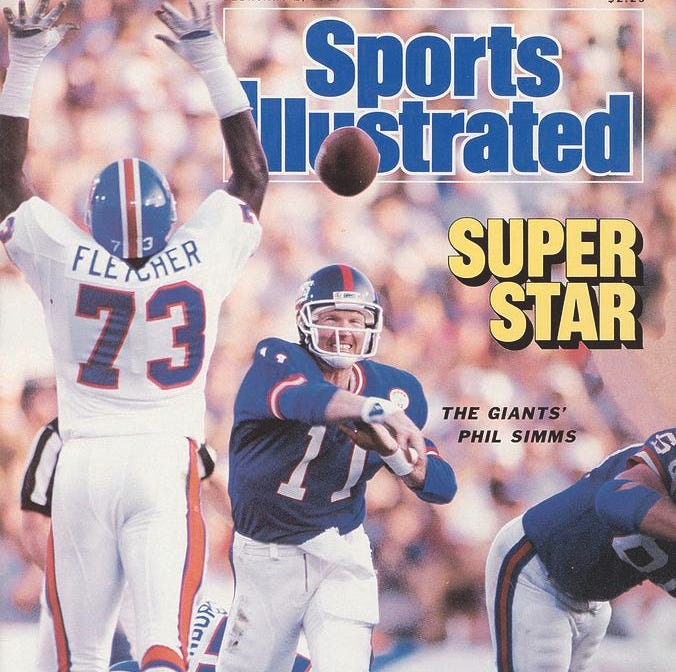
In 1987, Phil Simms completed 22-of-25 passes in a Super Bowl win over the Denver Broncos. That is another number I don’t need to bother to look up; it’s just there, waiting for me whenever I need it as I struggle to recall my pin number at an ATM. Twenty-two for twenty-five: Nobody threw a football with that kind of accuracy in those days, particularly in a Super Bowl. One of Simms’ teammates wondered after the game if perhaps he had entered some kind of robotic fugue state. “Somewhere inside the mind of every quarterback there’s a 22-for-25 day,” Paul Zimmerman wrote in Sports Illustrated, “a day when every pass has eyes and every decision is correct….That’s where the fantasy usually stays, inside.”
But all these years later, those days no longer seem to exist merely in the life of the mind. They are no longer the province of the mystical and the extraordinary. They are, believe it or not, an only mildly atypical afternoon for a quarterback like Sam Darnold.
II.
Here is what passes for ordinary now, a brief compilation of quarterback performances over just the past couple of weeks:
Darnold completed 21-of-24 passes in the Seattle Seahawks’ blowout win over the Washington Commanders, going 16-for-16 in the first half and setting the franchise record with 17 straight completions.
Drake Maye, the second-year quarterback for the New England Patriots, completed 16 straight passes and went 21-for-23, setting a franchise record for completion percentage (91.3) in a win over the Tennessee Titans.
Mac Jones, the backup quarterback for the San Francisco 49ers, completed his first 14 passes in a win over the New York Giants, and finished the game 19-of-24.
During the 1986 season, when Simms went 22-for-25, six quarterbacks completed more than 60 percent of their passes over the course of a season. In 2025, nearly every starting quarterback in the NFL completes more than 60 percent of their passes, and seven are over 70 percent, including Drake Maye, who leads the league at 74.1 percent.
It is true that football has been building to this zenith for quite some time.
Keep reading with a 7-day free trial
Subscribe to Throwbacks: A Newsletter About Sports History and Culture to keep reading this post and get 7 days of free access to the full post archives.