
Waiting Out the Rain with George Carlin
Baseball, football, and the increasingly ambiguous hinge point between them.

This is Throwbacks, a newsletter by me, Michael Weinreb, about sports, history, culture, and politics—and how they all bleed together.
If you like what you read, please click the button below, join the mailing list for FREE. And if you’ve been reading for a while, please consider joining the list of paid subscribers to unlock weekly paid posts and allow me to expand Throwbacks’ offerings. And please share it with one or two people you know.
I.
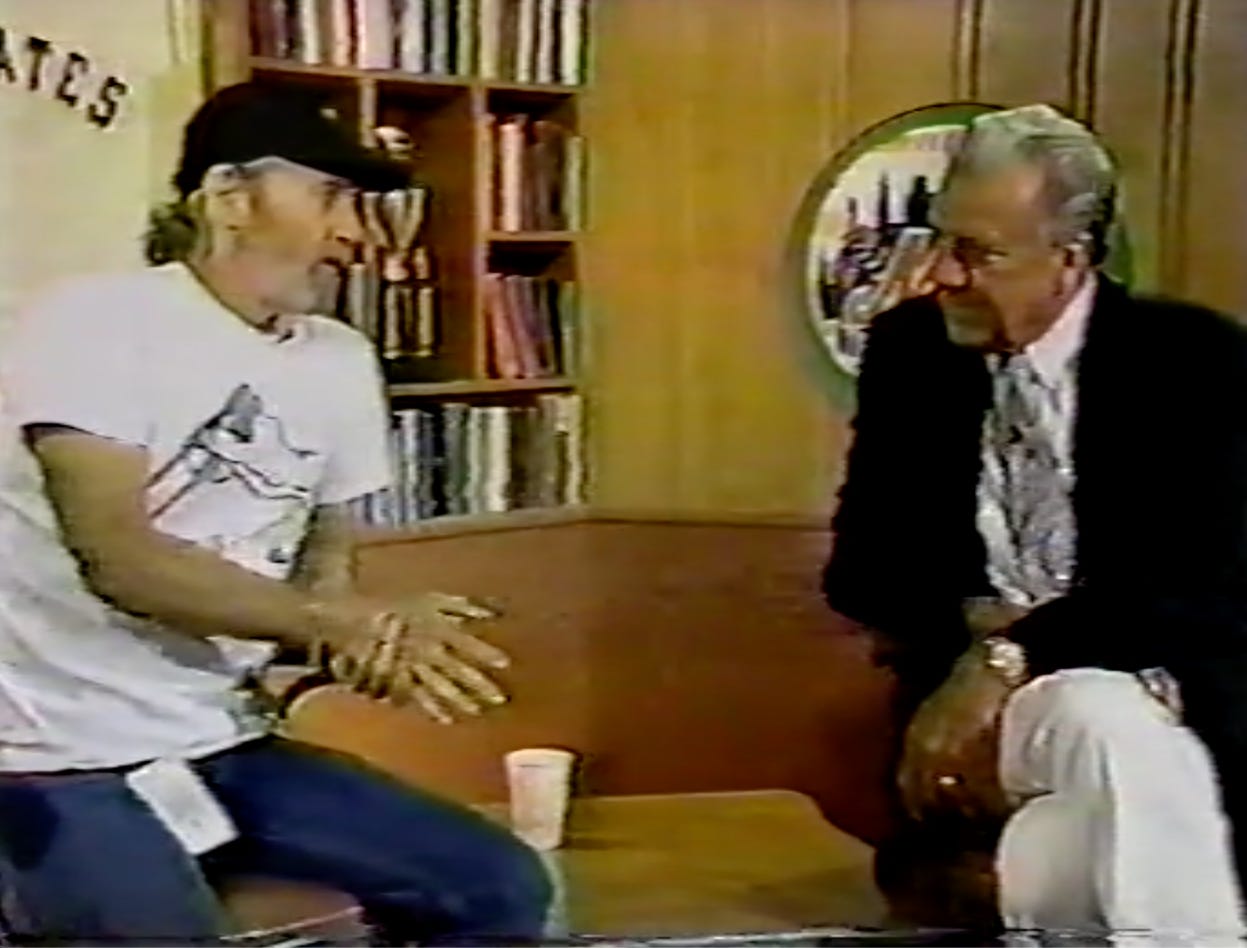
One Sunday afternoon in August of 1989, George Carlin found himself sitting in the dugout at Shea Stadium, waiting out the rain. He had come down from Boston to meet the Mets and watch them play baseball, and eventually, he agreed to go upstairs, onto the set of a show called Kiner’s Korner, whereupon ensued ten of the most enchanting minutes you’ll ever witness.
If you require additional context, allow me to oblige you: Ralph Kiner was a former ballplayer turned broadcaster for superstation WOR, which was one of those channels that beamed Mets game out across the country in the days when cable television was one of the great luxuries of modern life. Kiner was a genial sixty-six year old man who specialized in epic malapropisms, and Carlin was the great hipster comedian of his generation (or any generation), a guy whose joyful curiosity about the world was tempered by an exhausted cynicism. I imagine they had little in common in terms of their overarching worldview: Kiner was a Navy pilot in World War II, and Carlin served briefly as a radar technician in the Air Force, where he was court-martialed multiple times. But for those ten minutes, they talked about baseball, and they talked about the Brooklyn Dodgers, and they talked about Carlin’s hometown of New York City, and they vibed on a level that made them seem like they’d known each other their entire lives.
I don’t know if I was watching WOR that day, but I very well might have been, because if there was a baseball game on in the summertime, it was usually playing on the television in our basement. By mid-August, as the air conditioner hummed upstairs, you could feel the summer slipping away, and you found yourself clinging to every moment of it you had left before the grind of another school year. Football season would be here soon enough, and I loved football even more than I loved baseball, but there was something about that transition from one season to the next that always felt kind of daunting. And in a lot of ways, it still does.
II.
In 1975, on the very first episode of Saturday Night Live, George Carlin performed the greatest sports-related comedy routine this side of Who’s on First. And over the years, he mastered it to the point that it became perhaps the signature bit of one of the great stand-up comedy careers in American history.
The amazing thing about this routine, Baseball vs. Football, is that, like any great work of literature, it can be interpreted in a multitude of ways. The most-watched clip of it on YouTube (with over 3 million views) describes it as “George Carlin tells us why football rules and baseball sucks!” This is not true at all, because George Carlin loved baseball, and grew up with a deep fealty toward baseball, as is evident in that Kiner’s Korner clip. Yet, like most of us, I imagine he also enjoyed football, too. It wasn’t about one over the other; it was the contrast that defined them, and it was the contrast that defined us. It was the difference between pastorality and controlled violence, the difference between techno-futurism and nostalgia, the difference between stadiums and fields. It was about the fundamental cultural and political dichotomy of America itself, and it was about the fleeting nature of the seasons themselves.
Every year around this time, I come back to Baseball vs. Football, in large part because this is the hinge point where one begins to give way to the other. NFL training camps began this week, and injuries are already beginning to pile up, and coaches are speaking in martial cliches, and the unforgiving nature of football is making itself clear once again. “Training camp,” writes the columnist Mark Whicker, “is Code Red from the first whistle,” and the fascinating thing about it is how that transition seems to grow more abrupt every year.
III.
There are, as Jacob Stern recently wrote in The Atlantic, more games available to watch on television than there have ever been. The NFL season is almost certain to expand from 17 games to 18 soon enough, the College Football Playoff will soon expand even further, and everyone knows the NBA season is far too long but no one has the guts to do anything about it. The expanded playoffs in baseball have led to unprecedented parity, but have also meant that the World Series sometimes trickles into the first day of November.
All of this would have made 14-year-old me quite happy, but for middle-aged me, I will admit that sometimes it feels like just a bit too much to handle. Part of the problem is that the seasons now creep from one into the other; there is no room for one sport to breathe before the other sport creeps in. Summer used to stretch from Memorial Day to Labor Day, and this was baseball’s domain, but now there are mini-camps and training camps and NBA free agency and the WNBA and World Cup, and the kids are out of school and back to school in the course of weeks, and there is very little room to take a deep breath and watch George Carlin liven up a rain delay. This is true in a literal sense, but also in a cultural sense: Young athletes are pushed to specialize in a single sport in a way that appears unhealthy for their own happiness, and football, by sheer virtue of its overwhelming popularity, now creeps into every month of the year. Even modern sports journalism has emphasized the specialists over the generalists, and while many of these specialists are incredibly good at what they do, it results in a push for the prioritization of minutiae and the emphasis of tired and overplayed storylines over bigger, weightier ideas. The overarching effect is that there is less room to explore, less room to wander, less room to embrace time and space before it disappears altogether.
At the end of Carlin’s appearance on Kiner’s Korner, the rain had subsided and the sun had emerged, and Kiner offered to meet Carlin on Sunset Boulevard the next time he was in Los Angeles so they could grab a cup of coffee. And I don’t know if that meeting ever happened, but I’d like to think it did, and that they talked about baseball, and maybe they talked about football, too, a couple of disparate American icons engaged in a luxurious and unhurried conversation on a late-summer afternoon, with nothing to do but to wait out the rain.
This newsletter is a perpetual work in progress. Thoughts? Ideas for future editions? Respond to this newsletter, Contact me via twitter or at michaeliweinreb at gmail, or leave a comment below. If you enjoyed this newsletter, please join the list, consider becoming a paid subscriber, and/or share it with one or two people you know.
Kiners Korner - story behind the name.
The name originated from a short left-field area at Forbes Field in Pittsburgh—originally dubbed "Greenberg's Gardens" for Hank Greenberg—which was renamed "Kiner's Korner" after Kiner hit many of his prodigious home runs there.
Even before YouTube, I remember audio recordings of that routine.