
There Is No Perfect Call
One of the best days in modern soccer history showed that sports are fundamentally human.

This is Throwbacks, a newsletter by me, Michael Weinreb, about sports, history, culture, and politics—and how they all bleed together.
If you like what you read, please click the button below, join the mailing list for FREE. And if you’ve been reading for a while, please consider joining the list of paid subscribers to unlock weekly paid posts and allow me to expand Throwbacks’ offerings. And please share it with one or two people you know.
I.
When ninety minutes had passed and the soccer teams from Italy and the USSR had finished slogging through a relentless rainstorm to a 0-0 tie in the semifinals of the 1968 European Championship in Naples, the two captains walked downstairs to the dressing room, accompanied by a pair of team administrators. From there they watched as the referee extracted a faded coin from his pocket and asked the Italian captain, Giacinto Facchetti, to call it.
“Tails,” Facchetti said, and when the coin landed on tails, Facchetti went racing back upstairs, where he threw his arms up in celebration and seventy thousand fans began to celebrate one of the most capricious victories in the history of modern sports.
II.
The story, whether apocryphal or entirely real, goes like this: It was November of 1891, at the tail end of a match between a pair of British clubs, Stoke City and Aston Villa. The score was 1-0 in favor of Aston Villa (or 2-1, depending upon your choice of source), and time was running out, and the referee had just awarded a penalty kick to Stoke City. And then an Aston Villa player came up with an idea: He approached the ball and kicked it clear out of the stadium, thereby draining the final seconds off clock.
In the wake of that moment, it became clear that the rules were not adequate to keep pace with the inherent deviousness of human nature. And so a new concept was born, known as stoppage time, which allowed the referee to add minutes onto a game at his own discretion. The only way to ensure the integrity of the sport was to allow one person the extraordinary power to bend and stretch time as they saw fit.
III.
The thing you tend to notice when you watch a relatively novel American sport like soccer is just how arbitrary it all is. This is true, of course, of our institutional sports—that football officials spot the ball in crucial situations based largely on vibes, and that a check swing in baseball has no real definition at all, and that a block-charge call in the NBA is undeniably a matter of one person’s judgment. But when I see it in soccer, the repetition has not yet congealed into some kind of twisted logic in my own mind. And I find myself wondering just how these things became the way they are, and just how ineffable the rules of the game can truly be.
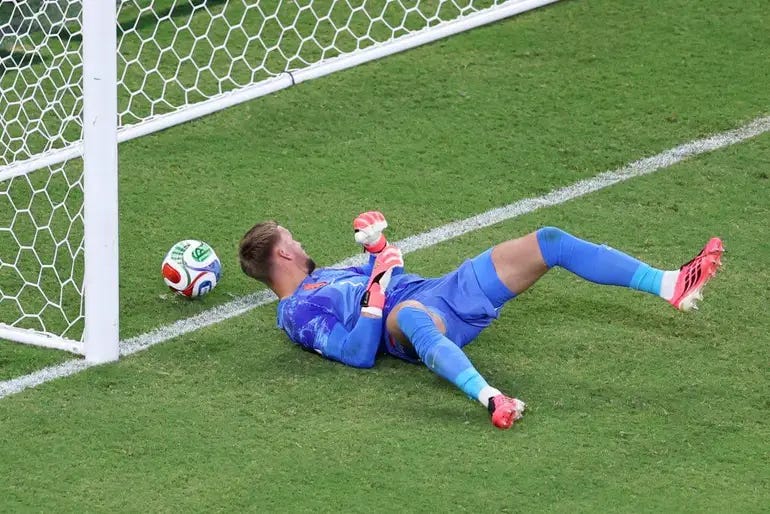
Monday was perhaps the most epic three-game stretch of soccer ever played on American soil. It was a day where every game continually hung by a thread, and where each one culminated in a series of events that made you ponder just what’s fair and what isn’t. The first match of the day in the World Cup knockout stage, between Brazil and Japan, came down to the final moments with a goal in stoppage time, which in recent years has been stretched and bent even further in order to expand at least the pretense of fairness. The other two matches, Senegal-Germany and Morocco-Netherlands, ended in wild and tense penalty shootouts, which was the solution devised for resolving international soccer matches after they began to realize that flipping coins and drawing lots was a completely random method for determining a winner. And that gifted us one of the most dramatic penalty-kick sequences in modern World Cup history.
You can argue, of course, that both stoppage time and penalty kicks are imperfect solutions, and you might not be wrong. You can make the case that shootouts are not much less arbitrary than a coin flip; you can make the case that a referee being the only one in the entire stadium who truly decides when a game actually ends is vesting a tremendous amount of power in a lone and fallible human being. You can argue, in an age of instant-replay and VAR reviews, that there should be a better and more quantitative method to solve these problems. But sometimes there isn’t. Sometimes we have to rely upon the impartiality of strangers, and sometimes we have to embrace these things as the most just method of determining a victor.
After the 1968 Olympic semifinal between Israel and Bulgaria ended in a 1-1 tie, the teams drew lots to determine the winner. Bulgaria won, Israel lost, in the wake of that defeat, a member of Israeli soccer’s executive committee wrote a letter to FIFA, declaring that drawing lots was “not a sportive way to win a competition.” Instead, he proposed, a winner could be determine by a rematch, and if the rematch ended in a draw, it could be determined by a series of penalty kicks. This was not a perfect solution, he admitted, but it was “more sportive and more convincing for both sides.” FIFA adopted the proposal, and so we spent much of Monday watching some of the most crucial moments in international soccer come down to isolated duels between a shooter and a goalkeeper, and people like to complain about it. But the simple truth as to why it continues to exist is because, in the years since, no one has ever come up with a better idea.
IV.
And yet we continually labor to keep solving these unsolvable problems. In 2022, FIFA revised the stoppage time rules to offer the referee more latitude to add stoppage time in order to keep players from stalling. Baseball has already added a balls-and-strikes challenge system and is experimenting in the minor leagues with a check-swing instant replay system that attempts to define that which was long undefined within the rules of the sport. The NFL has experimented with technology that could help officials spot the football, and college basketball keeps redefining its block-charge rules, and we’d like to think we’re getting closer to the platonic ideal of removing human judgment from sports and deciding things in a manner that feels more convincing to all of us.

But at some level, there’s only so much we can do. There will always be gaps that cannot be bridged by technology, and you might even say that these gaps are the most important part of the games themselves, because we are trusting other human beings to do the right thing. Stoppage time is imperfect, but as long as we believe the referee is doing the best we can, there is no better solution. Shootouts are imperfect, but as long as we agree there is no better way to end a soccer match, then what else can we do? At a moment when we are mired in blatant attacks on the very notion of impartiality and neutrality, and at a moment when machines have threatened the entire world order, there’s a strange comfort in this ambiguity. Those moments where we have to invest our trust in each other—those moments that force us to trust in some indefinable authority—feel like an increasingly rare reminder of why the games even exist.
This newsletter is a perpetual work in progress. Thoughts? Ideas for future editions? Respond to this newsletter, Contact me via twitter or at michaeliweinreb at gmail, or leave a comment below. If you enjoyed this newsletter, please join the list, consider becoming a paid subscriber, and/or share it with one or two people you know.