
The Undefeated Team College Basketball Doesn't Want
Fifty years after Indiana went undefeated, does winning still matter more than metrics?

This is Throwbacks, a newsletter by me, Michael Weinreb, about sports, history, culture, and politics—and how they all bleed together.
If you like what you read, please click the button below, join the mailing list for FREE. And if you’ve been reading for a while, please consider joining the list of paid subscribers to unlock paid posts and allow me to expand Throwbacks’ offerings, and please share it with one or two people you know.
Here’s a link to get 20 percent off a monthly membership for your first year:
And here’s link to get 25 percent off an annual membership:
(If you cannot afford a paid subscription and would like one, send me an email and I’ll comp you one, no questions asked.)
I.
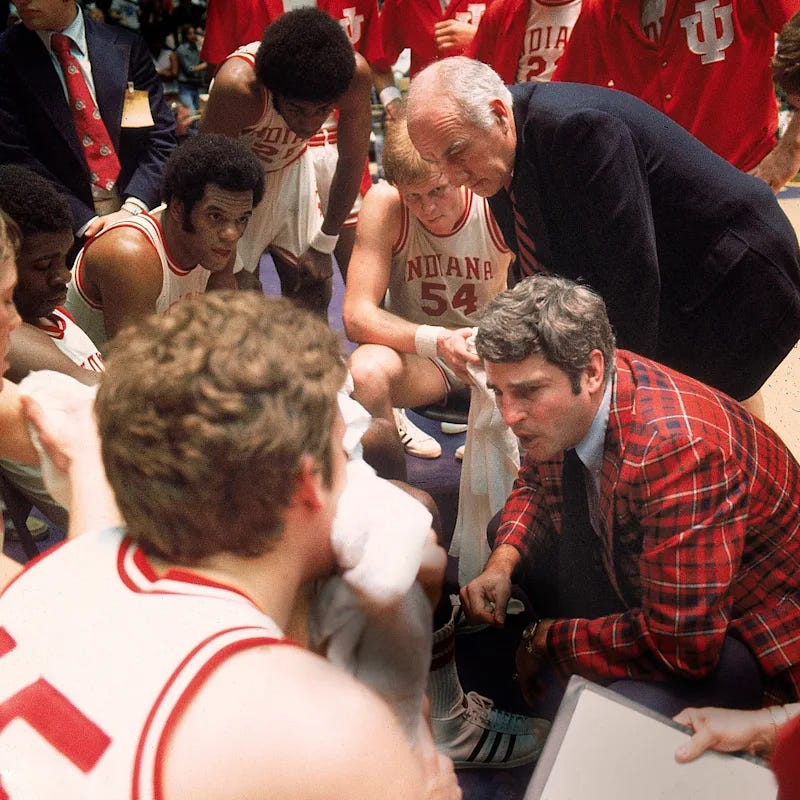
The last time it happened, so many things about college basketball—so many things about the world—were so completely different that it’s hard to even know where to begin. But maybe it’s best to start on the seventh of February in 1976, when the Indiana Hoosiers, having won eighteen games without a loss that season, found themselves trailing Michigan on their home floor by four points with barely half a minute left to play.
There was, as Sports Illustrated’s Jon Wertheim wrote, so much about that team that feels like a relic of a bygone era: The hardass drill-sergeant nature of their coach, Bobby Knight, or the fact that nearly all of the players on the roster hailed from somewhere in or around the state of Indiana. The NBA, that struggling professional sports league, was a distant dream waiting at the end of four years of college eligibility; the notion of getting paid beyond room and board and a scholarship for playing college basketball was merely unfathomable. But if there was one commonality with the world that exists fifty years later, it’s that it is still nearly impossible to go undefeated over the course of an entire basketball season, and the only way to make it happen is to be both very good and a little bit lucky.
That night in February in Bloomington, Indiana was both good and lucky: The Hoosiers’ star guard, Quinn Buckner, made his only field goal of the game to cut the lead to 60-58. Indiana fouled, Michigan missed the front end of a one-and-one, and Buckner heaved up a wayward shot with the clock running down, which was rebounded by the Hoosiers’ Jim Crews, who hurled the ball toward the basket, where center Kent Benson tapped the ball in just as the buzzer sounded. As Wertheim writes:
In 1976, a shot was good if it left a player’s hands before the buzzer. A tip-in counted only if it was already in the basket when the buzzer sounded. The officials huddled and ruled that Benson’s shot was a “shot,” much to the dismay of Michigan coach Johnny Orr. Indiana then pulled away in overtime and won 72–67. Such is the margin between heartbreak and history.
While Indiana remains the only team in the past fifty years to go undefeated and win a national championship, there have been five teams since that have gone undefeated over the course of the regular season. It is a dizzying and precarious feat, and the fact that a sixth team is on the verge of making it happen as we speak—and the fact that this team is so unknown nationally, and so lightly regarded by the analytics that it might not even make the NCAA tournament if it fails to go undefeated—might be the most definitive statement yet about how college basketball is nothing like what it used to be.

II.
There was a time, I think, for a lot of us, when college football season bled directly into college basketball season. It picked up slowly over the course of the holiday season, and then it became a salve to make it through the brutality of winter. It was the lifeblood of cities like New York and of small towns like Bloomington, long before anyone could even fathom that Bloomington would somehow become a football town. And that is not gone, but it is very much different than before.

Much of that is for good reason: Coaches like Knight, who governed far too often through physical and emotional abuse, are no longer tolerated in the sport. Athletes are well-compensated through NIL and free to make their own decisions in the transfer portal; the power structure is now more balanced than it ever was. But that sudden shock to the system has also shaken up the product itself. College basketball still builds into March, but it feels more splintered now; as with college football, it is enduring an age of disorienting transition, a moment where rosters are ever-changing and the game itself is just kind of hard to follow and overshadowed by the creeping length of the football season.
At the moment, Duke and Michigan are the top two teams in Ken Pomeroy’s influential statistical rankings, but among the top 20 are Vanderbilt and Nebraska, two teams that have won a total of zero NCAA tournament games in the past decade. That seems good, right? And yet other than Gonzaga, none of the top 20 teams hail from smaller or mid-major conferences; last season, every single Sweet Sixteen team in the NCAA tournament came from a major conference, and we may be headed for the same thing again this year. The top has been shaken up by NIL and the transfer portal, but the lower half of college basketball—the teams that have traditionally made the NCAA tournament what it is—has largely been left behind by the analytical framework of the sport. Which is how the lone undefeated team in college basketball right now might not even be regarded as one of the 68 best teams in the country.
III.
As I write this, the basketball team at Miami (Ohio) is 28-0. This is a remarkable turnaround story: Four years ago, when current coach Travis Steele took over, Miami hadn’t had a winning season since 2009, and hadn’t made the NCAA tournament since 2007. And yet Steele won 25 games last year, and then came this season, when a group of two- and three-star recruits have, at least so far, beaten every team they played, winning games on precarious buzzer beaters and insane off-balance shots to force overtime.
Miami (Ohio) would appear to be everything we seem to proclaim we want out of college sports in this era of uncertainty: A team laden with veterans who decided not to transfer and coaches and support staff who decided to stay put. They are a team who embraced the best of what Indiana represented in a bygone era of college basketball. “Everybody wants instant success every year because of the portal and NIL,” Steele told Matt Norlander of CBS Sports. “We had to build it the slow-and-steady way."
And yet if the Redhawks were to lose one of their final regular-season games, and/or to lose in the Mid-American Conference tournament, there is a very real chance that they will not get in at all. This is because the advanced metrics that now dictate the NCAA tournament don’t favor them: They have zero Quad 1 wins, which is the new way of declaring they ain’t played nobody, Pawl; their “predictive metrics” on sites such as KenPom.com—where Miami is currently ranked 83rd—are not great.
“So, come Selection Sunday,” writes ESPN’s Jeff Borzello, “will committee members ultimately prefer inconsistent teams that have proved they can beat teams in the field like TCU, or teams that have shown the ability to win consistently for four straight months and avoid losses like Miami?”
IV.
I had to read that sentence four or five times in order to fully comprehend the absurdity of it. It’s not Borzello’s fault for pointing this out, but I think it gets at what’s gone wrong here. I think it shows us how we’ve lost sight of the central purpose. The thing about the NCAA tournament, and about college basketball as whole, was that it always felt fraught with possibility. But if winning matters even less than the metrics—if even going undefeated for four straight months isn’t enough to convince you of a team’s inherent worthiness over a major-conference team that lost by 26 points to Colorado—then what are we even doing here?

This is not an argument for going back to the way things used to be. But it is an argument that maybe part of the reason college basketball has lost its way is because it’s abandoned some central element of what made it great in the first place. This used to be a sport that felt democratized, that offered a place for a team like Miami (Ohio) to prove how good it actually is without working it through a formula. Nearly everything has changed about college basketball, and yet it is still nearly impossible to win every one of your games, and maybe it says something when it happens—or even when it comes close to happening. And if that kind of thing isn’t rewarded, I’m not sure how this sport begins to find its way back.
This newsletter is a perpetual work in progress. Thoughts? Ideas for future editions? Respond to this newsletter, Contact me via twitter or at michaeliweinreb at gmail, or leave a comment below. If you enjoyed this newsletter, please join the list and/or share it with one or two people you know.
Let's just expand the field to 256 so every team has a chance to participate in March Madness and coaches will have unlimited job security.
100%