
The Throwbacks Endorsements, March 2026: Going Long
A film, a book, and the radical act of paying attention.

This is Throwbacks, a newsletter by me, Michael Weinreb, about sports, history, culture, and politics—and how they all bleed together.
If you like what you read, please click the button below, join the mailing list for FREE. And if you’ve been reading for a while, please consider joining the list of paid subscribers to unlock paid posts and allow me to expand Throwbacks’ offerings, and please share it with one or two people you know.
Here’s a link to get 25 percent off an annual membership for a limited time:
(If you cannot afford a paid subscription and would like one, send me an email and I’ll comp you one, no questions asked.)
I. Marty Supreme, dir. Josh Safdie (2 hours, 29 minutes)
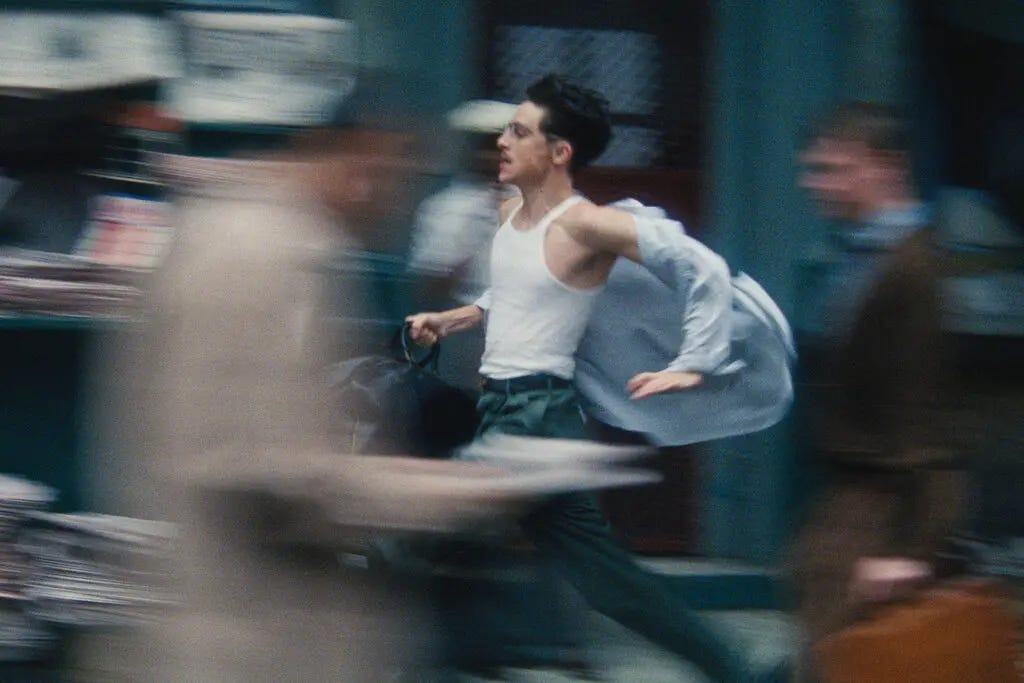
There is a scene early in the movie Marty Supreme where a bathtub comes crashing through the ceiling of a cheap motel. I don’t think this would qualify as a spoiler, except to establish that this is not a movie that traffics in subtleties or eases you into its world. Instead, it lifts you up by the lapels and shouts in your face as the spittle flies. Marty Supreme is an epic sports film—the best sports movie of the decade, I’d argue—about an ambitious striver, a driven table-tennis player who will do anything to succeed, including debase himself, and who makes no apologies for who he is. Despite the fact that it got shut out at the Oscars last weekend, I think Marty Supreme is a sports movie that will endure, because it captures the restless and kinetic energy of a certain kind of New York hustler better than any work of art since Budd Schulberg’s novel What Makes Sammy Run.
The thing you realize, when you live in New York for an extended period of time, is that people like Marty Mauser are all around you. I found them on the one-wall handball courts of New York City, where I once spent months researching a long newspaper feature about the elite players who hustled each other for a living in a sport that only truly thrived in New York City. I found them huddled over the chess boards in Washington Square Park, where, in the midst of researching a book, I watched a delinquent high-school kid from Brooklyn attempt to squeeze a few bucks out of the tourists playing speed chess. Many of the New York hustlers you come across are fascinatingly complex characters; many of them are hopelessly toxic, the Kevin O’Learys of their respective domains, like the famed Irish chef who once opened a pulsating nightclub beneath my apartment and turned out to be kind of a con artist himself.
There is no place that breeds this energy like New York City, both for better and for worse. I viewed Safdie’s film as a kind of cautionary tale, in the same way What Makes Sammy Run—Schulberg’s 1941 novel about a ruthless Hollywood executive—became a cautionary tale about what America was in danger of becoming if it ignored the toxic elements in its midst in the leadup to World War II. As Schulberg wrote in an afterword to the book nearly 50 years later:
Individualism run rampant, an arrogant disregard for the views and welfare of our fellow man…In the closing lines of What Makes Sammy Run I had described his meteoric career “as a blueprint of a way of life that was paying dividends in America in the first half of the twentieth century.”…It’s Darwin time, survival of the fittest! Sure, all people are created equal. Only Sammy Glick is created more equal than the schleppers, get it?
O.K., that’s how they’re reading it in 1989. And if that’s the way they go on reading it, marching behind the flag of Sammy Glick, with a big dollar sign in the square where the stars used to be, the twentieth-century version of Sammy is going to look like an Eagle Scout compared to the twenty-first.
I understand why Marty Supreme came up empty at the Oscars. It’s difficult for a bleak vision like that to catch on in real time, given that we are currently living under the thumb of the most toxic New York striver in modern history—and given that its two biggest competitors were also epic (and truly excellent) films that served as allegories about fighting fascism and combating racism. I understand, as well, that Timothee Chalamet may have thrown himself so deeply into this portrayal because he could relate to Marty’s striving in ways that have now rendered him oddly toxic, and the Oscars are a political exercise as much as any kind of real reflection of artistry. And if you are feeling especially cynical, you can also make the case that movies don’t matter anymore because movies are a withering art.
But I don’t think Marty Supreme will disappear any more than Sinners or One Battle After Another will fade from view anytime soon. We are in fight for the survival of culture itself; all three movies have a place in that fight. Someday, when we come out of this, I wonder if Marty Supreme will serve to remind us of the cruelty and emptiness of the modern era, and how it’s on us to refuse to repeat it.
II. The Power Broker, by Robert Caro (1344 pages)
This is kind of a cheat, because I’m only about forty pages into this book, and I have no idea if I’ll ever muster the courage to finish it, but here is what I can say: This is already one of the best nonfiction books I have ever read, and I am embarrassed that it’s taken me so long to pick it up in the first place. The level of detail is so deep that I’m not even sure what word to use to characterize it, other than intense. Witness this paragraph about Robert Moses’ childhood home:
Dinner was served—off the finest Haviland china—in a paneled dining room along one wall of which stood a tremendous sideboard bearing gleaming crystal decanters. After dinner, the family would repair to the library, whose walls were covered with Rembrandt and Durer prints, and Old Annie would pour coffee from a silver coffeepot into French demitasse cups—each cup a different bright color—that cost twenty-four dollars apiece.
There is something almost subversive about even attempting to immerse yourself in a book like The Power Broker in the year 2026. It is a way of forcing your brain to slow down, to focus, and to appreciate the efforts of a single writer who has spent his entire adult life researching two unbelievably complex men (Moses and Lyndon Johnson) who epitomized the 20th-century yearning for power and influence in America. It takes energy to ignore the shallow and superficial temptations of the outside world—the endless algorithm with its twelve-second videos of dancing chihuahuas—and throw yourself into any book, let alone a book that weaves a thousand-page tale of an urban planner. But just as Marty Supreme rewarded the act of walking into a theater and spending two-and-a-half hours watching a young man become a cautionary tale about individualism run rampant, The Power Broker does the same thing.
Recently, The New York Times ran a quiz which asked you to compare two short literary passages. One was written by A.I., the other written by a human; it did not tell you which was which. And I will admit, in several cases, I preferred the A.I. writing, because it is very good at cobbling together four or five sentences that carry a certain musicality.
But I’ve also seen what A.I. becomes when the prose stretches out and the ideas grow more complex. It lapses into wooden cliches that are often laughable. It is not built to sustain complex literary ideas, or to research as deeply and carefully as Robert Caro has. That’s what books are for, and that’s what epic films like Marty Supreme and Sinners and One Battle after Another are for. And if it is an act of insurgency to continue to embrace these supposedly dying mediums—to throw yourself into a thousand-page book or a two-and-a-half hour movie while distractions rage all around you—then count me in on the rebellion.
This newsletter is a perpetual work in progress. Thoughts? Ideas for future editions? Respond to this newsletter, Contact me via twitter or at michaeliweinreb at gmail, or leave a comment below. If you enjoyed this newsletter, please join the list and/or share it with one or two people you know.
Hang in there reading The Power Broker, its is long, but well worth it. Moses accumulated what appeared to be endless power, until finally people tired of his bullying. Projects were no longer rubber stamped and his power removed. Memory thinks it was Nelson Rockefeller administration? Moses story reminds me of Mayor Reed in Harrisburg, Vince Fumo in Philadelphia with the board of trusts, etc.