
The NBA Doesn't Need A Dictator
Adam Silver, Pete Rozelle, David Stern, and the seductive myth of strongman leadership.

This is Throwbacks, a newsletter by me, Michael Weinreb, about sports, history, culture, and politics—and how they all bleed together.
If you like what you read, please click the button below and join the mailing list for FREE. And if you’ve been reading for a while, please consider joining the list of paid subscribers to unlock paid posts and allow me to expand Throwbacks’ offerings, and please share it with one or two people you know.
I.
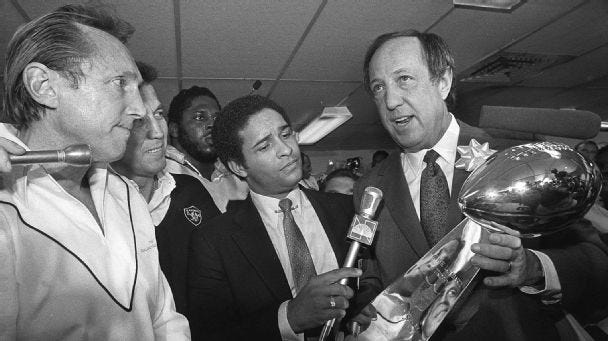
There is a case to be made that the greatest rivalry in pro football history never played out on an actual football field. This rivalry commenced in the years before the merger of the National Football League and the American Football League in 1966, when two men who represented the opposing poles of modern society first crossed paths; it raged for the next two decades in boardrooms and courtrooms and on the pages of newspapers and glossy magazines. One of those men was Pete Rozelle, the commissioner of the National Football League. The other was Al Davis, the owner of the Oakland/Los Angeles/Oakland Raiders.
Rozelle was a Southern California-born public-relations man who built his power by charming a room. “He used his soothing, honey-coated manner of diplomacy” wrote author Mark Ribowsky, “to amass a barrow of goodwill.” Rozelle was 33 years old when he became commissioner—his nickname was “The Boy Czar”—and as he grew into the job, he succeeded in convincing a room full of disparate owners to embrace the collective good of the league over the will of their own franchises. And Davis, a combative and conniving Brooklynite who thrived on guerilla warfare, viewed Rozelle as the antithesis of everything he stood for.
Long after Rozelle was named commissioner of the newly merged NFL and Davis was displaced from his brief tenure as the commissioner of the AFL, Davis continued to believe that the only way to succeed was to attack, attack, attack. By the early 1980s, as Davis nakedly defied Rozelle by importing his team from Oakland to Los Angeles, there was a sense that Rozelle’s slick style had run its course, and that a league besieged by drug use and labor disputes and by the looming threat of the USFL had perhaps lost its way. Davis had succeeding in making it increasingly personal; he accused Rozelle of turning the NFL into “political theater.”
The more you read about the Al Davis and Pete Rozelle, the more you start to wonder whether within their rivalry lies some essential dichotomy in the American character—one that we’re watching play out in real time in the 21st century. Is there still a place for the leadership style of Pete Rozelle in a world overwhelmed by performative noise and defined by naked conflict? I thought about that again the other day, as I read a profile of another commissioner whose league appears to have lost its way.
II.
“The NBA is always in trouble,” Chuck Klosterman wrote nearly 20 years ago, and I think about that sentence all the time, because every time you believe maybe that sentiment has become dated, it circles back again. For a time in the 2010s, the NBA felt surprisingly stable, but apparently it was only a matter of time, because now the NBA is in trouble again, and this time, it is commissioner Adam Silver who is at the heart of the angst. That led an Atlantic writer named Tim Alberta to agitate for an interview with Silver, and to write a profile that essentially mused about whether Silver was somehow too soft to survive this moment of transition.
Alberta—a talented reporter who normally covers politics—writes through the lens of his childhood fandom of the rough-and-tumble Detroit Pistons, and seemingly laments the way the league has essentially gone soft in the years since. At the same time, he looks back longingly on the tenure of commissioner David Stern, who ran the league with a dictatorial fervor, and he wonders whether perhaps Silver is so focused on making money that he isn’t willing or able to confront the big problems the league faces. The key moment in the profile comes when Silver recalls how harshly Stern treated people—“It was devastating to some people to be talked to that way, and it was unnecessary,” Silver says—and how Stern once said to him, “It’s too important to you to be liked.”
What disturbed me was that this exchange was portrayed as an indictment of Silver rather than a condemnation of Stern. Maybe, Alberta implies, it means Silver is too weak to meet the moment; just as the NBA, in Alberta’s view, had kind of gone soft in the years since the Pistons had stopped beating the hell out of opposing shooters and given way to the era of Steph Curry beautifying the game, maybe Silver had facilitated that softness by refusing to embrace the dictatorial fervor of his predecessor.
Writes Alberta:
Companies take on the personality of their leader. For 30 years, the NBA was a reflection of David Stern: feisty, colorful, unpredictable, entertaining. Silver’s NBA has embodied his best qualities—competent, commercially successful—while also suffering from a certain dispassion, the type that suggests someone who has never fought to survive, only to maintain.
I think there are legitimate questions about how the NBA moves forward from here, and Alberta raises many of those. This is a league that is perpetually obsessed with imagery above all else, and it is possible that Silver may be overly concerned with that imagery. But what bothers me most is that Alberta portrays Silver’s modesty and attempts to strive for a kind of quiet competence—his refusal to force himself directly into the story, and his reluctance to act out for the cameras—as an inherent weakness.
At one point, Alberta compares Stern favorably to Vince McMahon, the odious and perpetually over-the-top leader of World Wrestling Entertainment, and a man who essentially presaged the performative buffoonery of the current president. And that makes me wonder if perhaps being ensconced in the bubble of modern politics has completely skewed certain people’s notions of what leadership can actually look like.
III.
Early in his tenure as NFL commissioner, writes the late author David Harris, Rozelle went to meet with Washington owner George Preston Marshall, a blowhard and virulent racist who was nearly impossible to deal with. Rozelle sat patiently and listened as Marshall berated him, as he declared that Rozelle was in diapers when he helped found the NFL, as he went on and on until Rozelle circled back to the original reason for his meeting. “Mr. Marshall,” Rozelle said, “you still haven’t answered my question.” Eventually, Rozelle got the answer he was seeking.

This, writes Harris, was the key to Rozelle’s success, even at a moment of crisis: He subordinated his own ego, remained dispassionate and persistent, and convinced the stakeholders involved that the good of the league mattered more than any individual’s needs, including—and especially—those of Al Davis.
Said Rozelle of the NFL owners:
You have to be patient with them and when they’re up-tight and angry about something, you’ve got to be cool, get as much information on the subject as you can and try to convince them with logic, using as a basic premise the fact that when we stay together on something, we’re normally successful and we grow. When we’re going to splinter off, we’re not as successful. It’s mainly just patience, calm preparation, with, I guess, a degree of political persuasion.
It is worth noting that Al Davis won several of his battles, but in the end, Rozelle won the war. The Raiders wound up moving back to Oakland from Los Angeles, where they struggled in Davis’s later years as he micromanaged his dynasty to oblivion. The USFL—due in large part to the performative aggression of the current president—blew itself up while Rozelle patiently waited it out. The labor and drug issues were resolved, the television contracts ballooned, and Pete Rozelle became the greatest and most successful commissioner in the history of American sports. And I don’t know how this whole thing plays out for Adam Silver, but when a sense of dispassion is somehow viewed as a political weakness—and when dictatorial leadership and performative contempt are viewed as the only way forward—then maybe it’s worth wondering if we’re the ones who are in trouble.
This newsletter is a perpetual work in progress. Thoughts? Ideas for future editions? Respond to this newsletter, Contact me via twitter or at michaeliweinreb at gmail, or leave a comment below. If you enjoyed this newsletter, please join the list, consider becoming a paid subscriber, and/or share it with one or two people you know.
"performative buffoonery" is too kind for Trump who has wasted billions of dollars and cost thousands of lives in Iran. Let's try "criminally incompetent?"
As always, spot on. We should celebrate Silver’s humility and “niceness”, not denigrate it.