
The Ballet Dancer (1981)
Lynn Swann, Rich Rodriguez, and the odd state of modern masculinity.

This is Throwbacks, a newsletter by me, Michael Weinreb, about sports, history, culture and politics, and everything in-between.
If you like what you read, please click the button below, join the mailing list for FREE and please share, on social media or through e-mail or however you feel comfortable sharing.
And if you’ve been reading for a while, please consider a paid subscription to unlock certain posts and help keep this thing going—you’ll also get full access to the historical archive of over 200 articles. (Click here and you’ll get 20 percent off either a monthly or annual subscription for the first year.
(If your subscription is up for renewal, just shoot me an email and I’ll figure out a way to get you that discount, as well. If you cannot afford a subscription and would like one, send me an email and I’ll comp you one, no questions asked.)
I.
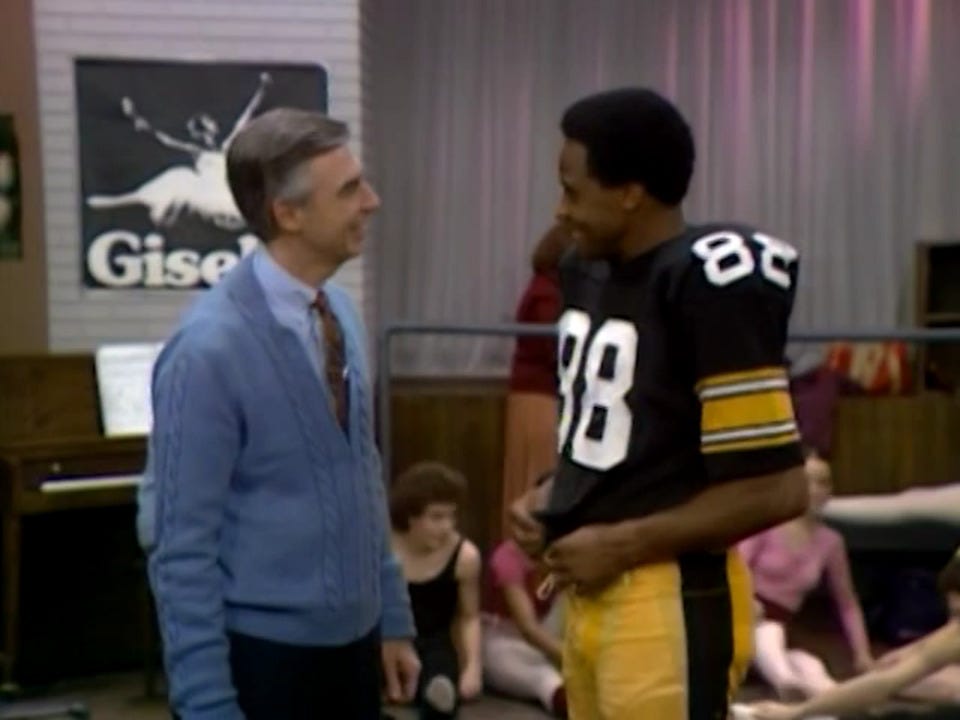
In June of 1981, at the tail end of a professional football dynasty, Lynn Swann walked into a ballet studio wearing his Pittsburgh Steelers uniform. He was greeted by a man named Fred Rogers, and over the course of the next several minutes, as he systematically stripped off that uniform and ended up in sweatpants, he broke down the purpose of his football equipment, piece by piece. “Those are certainly not shoes you’d wear for dancing,” Mister Rogers exclaimed, as Swann showed him his turf cleats.
It was not exactly a state secret before this episode of Mister Rogers’ Neighborhood aired that Lynn Swann studied ballet. On every television broadcast, that fact would come up. When Swann made catches like this one during Super Bowl X in 1975, the whole ballet thing folded into his legend:
In retrospect, that episode of Mister Rogers—like every episode of Mister Rogers that you rewatch when you’re older—is a remarkable reminder of just how dumb adults can be when we ignore the basic tenets of human decency. It is hokey and it is lovely, and it might choke you up despite yourself, especially right now. The way Swann seamlessly transitions from football into dancing with a partner is choreographed as an unspoken metaphor about breaking down stereotypes. After that, in classic Mister Rogers fashion, things get trippy in the Land of Make Believe: Swann refuses to dance at first, then later tells a puppet named King Friday that he was upset he lost his football game, to which the king asks Swann if he did his best. Swann says yes, and the King says, “Well, then, you won,” and lessons are learned by all.
“What’s most important to me” above winning and losing, Mister Rogers says at the end of the episode, “are inside things.”
I don’t want to get all hokey myself here, but I dare you to watch this and not feel something. Mister Rogers has a way of breaking you down into a raw emotional being (for more, I refer you to the brilliant work of writer Tom Junod, who was way ahead of the curve on this); his lessons stick with you in the way a productive hour of psychotherapy sticks with you. As a sports-obsessed young person, the central idea of that whole Lynn Swann-ballet thing—the notion that a man can play football and be a ballet dancer without somehow compromising himself—stayed with me as I began to define who I was. And it came back to me again this week, thanks to the comic ramblings of one of the strangest football coaches in America.
II.
In a field populated by hyper-aggressive control freaks, there are few college football coaches more consistently inscrutable than Rich Rodriguez. Here is a man who made his name by building an offense around one seemingly unstoppable play called the zone read (or read option) at a small college in West Virginia, then got his dream job coaching at West Virginia University, where he nearly led them to a national championship in 2005. And then, for reasons that still defy explanation, Rodriguez left to coach at Michigan in 2007, where he alienated nearly everyone he came into contact with. After that disaster, he went to Arizona and got fired again. In 2021, he landed a head-coaching job at Jacksonville State, won nine games in two consecutive seasons, and then somehow landed back at West Virginia in December of 2024.
Make of that absurd redemption-to-failure-and-back carousel what you will. That is not really what I am here to discuss. What I am here to discuss is what Rodriguez said this week in reference to his players performing dances on Tik-Tok, which is one of those things young people do that many older people seem to think portends the end of society as we know it (notwithstanding that Tik-Tok is potentially a Chinese intelligence asset, which feels like a trend that is far more relevant to the end of society as we know it).
Here is the odd thing: Rodriguez did not say anything about completely banning his players from Tik-Tok. Instead, he said he was specifically banning his players from dancing on Tik-Tok. “We try to have a hard edge, whatever,” Rodriguez said. “And you’re in there in your tights, dancing on TikTok. It ain’t quite the image of our program I want.”
III.
Now, as Rodriguez later stated, it is his program, and he’s allowed to do whatever the hell he wants when it comes to these things. He ascribed his policy to the notion that football should be less about individualism and more about the collective, which, I mean, fine. But he then went off a tangent about how his players could do what they wanted 20 years from now, “sitting in their pajamas in the basement eatin’ Cheetos and watching TikTok or whatever the hell they can go at it. Smokin’ cannabis or whatever? Knock yourself out.”
I will admit: I’m not entirely sure where Rodriguez was going with all of this, but I’m going to attempt to interpret. I’m assuming, in Rodriguez’s mind, having a “hard edge” equates to masculinity, and that, in his mind, TikTok dances do not equate to masculinity. Instead, Rodriguez, like the preacher in Bomont, Utah, believes that dancing leads to the ruination of man. Which I guess is also his right. Yet this was such a dynamically weird proclamation that even Barstool Sports, the Internet’s epicenter of performative masculinity, didn’t even seem to know how to react. And I don’t, either, except to say that it is all very strange, this regressive cultural moment we’re living through, and I have to imagine Mister Rogers would find it all quite horrifying.
Not long ago, Lynn Swann appeared on Peyton Manning’s television show, and they discussed—of course—ballet. Swann told Manning that every athlete who jumps is essentially performing a ballet move called a plie. Swann is in his 70s now, and he still looks great, and save for a misguided attempt to become a politician, he has not been relegated to eating Cheetos and smoking cannabis because he displayed a predilection for dance as young man. At the same time, perhaps it is worth noting that West Virginia’s leading receiver last season has already transferred to lllinois.
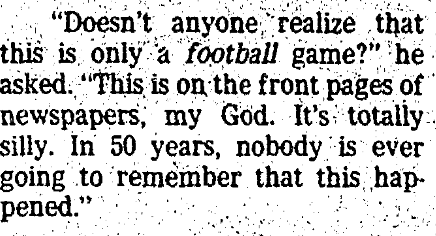
Bonus Archival Newspaper Quote of the Week
From the San Francisco Chronicle, January 25, 1982, the day after the 49ers won their first Super Bowl.
This newsletter is very much a work in progress. Thoughts? Ideas for future editions? Contact me via twitter or at michaeliweinreb at gmail, or leave a comment below. If you enjoyed this newsletter, please subscribe and/or share it with others.
This goes back to the early 80s and is about a friend of Swann's (as I recall) . A guy wrote he was at a ballet when a dancer executed a grand jete. Someone in the audience went "Errrving", referencing of course the great Dr. J. Both Swann and the Doctor were exciting to watch bringing their natural dance moves to their respective sports.
Think about how we attempted to emulate athletes like Mike, Bo, and Barry over the years and how those rare athletes with danceable abilities are almost always rewarded with a higher public rating in nearly every sport—with the possible exception of chess. Rich Rod dunno what the hell he’s talking about.