
Nolan Ryan and the Last True Fastball
What did baseball lose when 100 m.p.h. became pedestrian?

This is Throwbacks, a newsletter by me, Michael Weinreb, about sports, history, culture, and politics—and how they all bleed together.
If you like what you read, please click the button below, join the mailing list for FREE. And if you’ve been reading for a while, please consider joining the list of paid subscribers to unlock paid posts and allow me to expand Throwbacks’ offerings, and please share it with one or two people you know.
I.
On a Tuesday in August of 1974, Nolan Ryan pitched the kind of epic game that has long since gone extinct. That night, Ryan threw nine shutout innings for the California Angels against the Detroit Tigers, only to find the game tied at the end of the ninth. Both Ryan and Tigers starter Mickey Lolich carried on into the 10th, and then into the 11th, when Ryan gave up a pair of singles in the top of the inning that would deliver the Tigers a 1-0 win. Ryan gave up four hits over the course of the night, walked five, and struck out 19 (it was, in fact, the second time in eight days that he’d struck out 19 hitters in a game). This was Ryan’s 13th loss of the season against 16 wins; he would wind up pitching 332 2/3 innings that year, walking 202 hitters and striking out 367.
Ryan may or may not have been the greatest pitcher in modern baseball history, but he was unquestionably the most enjoyable to watch. He slung pitch after pitch after pitch, many of them the same laser beam that once got him discovered by a scout in rural Texas when he was an impossibly skinny teenager (that scout, Red Murff, upon Ryan watching uncork his first fastball, wondered for a moment whether he’d had a break with reality. How in the world, he asked himself, could anyone that kid’s size throw like that?). He threw hard, he threw inside, and he never let up, even after 11 innings. And this particular game against the Tigers in 1974 proved to be a watershed moment, both for Ryan and for baseball itself.
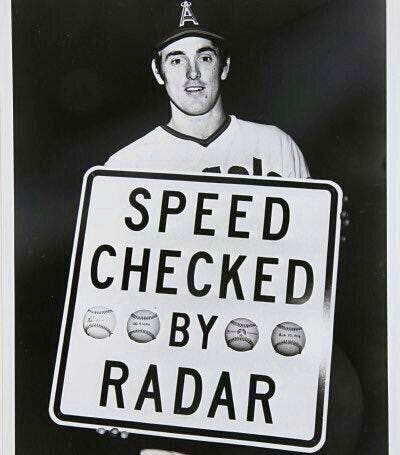
That evening, for the first time, a group of men from Rockwell International’s Electronic Research Division had set up a infrared radar in the press box, which projected over the catcher’s head and onto the dirt near home plate. This was a test run, and that night, writes the author Tim Brown in his new biography Nolan: The Singular Life of an American Original, “Ryan threw four pitches of 100 m.p.h or better, two that registered 100.9 m.p.h.”
Two and a half weeks later, Rockwell debuted the equipment to the public as Ryan pitched against the White Sox. The speed of Ryan’s fastball lit up on the scoreboard, inning after inning, as Ryan stretched out and reached 96, then 98.8, which was faster than rudimentary devices had once recorded Cleveland’s Bob Feller. Finally, in the ninth inning, as Ryan finished off yet another complete game—his seventh in his last nine starts—he uncorked a fastball to Chicago’s Lee Richard. The display read: 00.8, as there weren’t enough bulbs to add the 1.
“The crowd cheered,” Brown writes. “Nolan Ryan had broken the scoreboard.”
II.
Even in his own time, Nolan Ryan felt like a throwback to some Rockwellian era of American life. Ryan pitched game after game, week after week, year after year, until his longevity became both a medical mystery and the central part of his folklore. When Sports Illustrated’s Leigh Montville went to watch Ryan hurl fastballs on a Texas farm in 1992, he painted a portrait of a man who seemingly existed outside of time itself, a throwback to the Gary Cooper cowboy archetype. This was a man who would, the next year, at age 46, lasso Robin Ventura around the neck like a baby calf and throw a few haymakers straight into his gullet.
“The fact that he can still compete with the young and wild-eyed millionaires of his game and still make them look silly is only the beginning,” Montville wrote. “Here is Nolan Ryan, cut from a good bolt of denim cloth and served with a glass of milk and no apologies.”
By the time his career ended—by the time he finally, actually did throw out his arm— Nolan Ryan had transformed into a living, breathing American myth. How much was that myth grounded in reality? It’s hard to say, though in Brown’s book, the legendary Dallas broadcaster Dale Hansen calls Ryan one of the last bastions of the classic Texas archetype. “Strong, but quiet,” he says. “At least that’s the way we used to be until the Ted Cruzes of the world came along.”
What was most interesting about Ryan, in retrospect, had nothing to do with the cowboy imagery and everything to do with the fact that he always seemed to be laboring so hard to keep it going. Every pitch Ryan threw felt like it threatened to take years off his life, let alone his career. He worked out before games and after games, riding stationary bikes and reportedly dunking his arm in a bucket of uncooked rice to strengthen it. He wound up tightly, almost as if curling himself into a ball, and then he let loose, and the radar gun, once it became a regular fixture, routinely popped a hundred. And then he reared back and did it again.
Everything that happened along the way was kind of an epic western adventure all its own. In addition to setting the all-time career record for strikeouts, Ryan also set the all-time career record for walks. One year when he was pitching in Houston, he won eight games and lost 16, despite an ERA of 2.76. He was so underappreciated in his prime, so regarded as a kind of primal pitching machine, that he never won a Cy Young award. Writes Brown:
His imperfections were legendary…He walked too many batters, booted too many comebackers, ignored too many base runners, lost too many games, and heaved too many wild pitches, any one of which might have muddled a typical career before it got started.
In a way, Nolan Ryan succeeded because baseball allowed him the room to succeed. He was, it turned out, a freak of nature, in that his arm held up for 25 years. But even so, he was allowed to labor through his imperfections until he crafted something entirely unique. And less so than the gauzy Texas mythology which never really existed in the first place, I think this is the thing we’ve lost.
III.
“In 2008, there were just two hundred and fourteen pitches thrown at a hundred miles per hour or more,” writes the New Yorker’s Louisa Thomas. “In 2025, there were 3,701 of them.”
