
"Lou Holtz Was Not Made for Professional Football" (1976)
He was made for a version of college football that no longer exists.

This is Throwbacks, a newsletter by me, Michael Weinreb, about sports, history, culture, and politics—and how they all bleed together.
If you like what you read, please click the button below, join the mailing list for FREE. And if you’ve been reading for a while, please consider joining the list of paid subscribers to unlock paid posts and allow me to expand Throwbacks’ offerings, and please share it with one or two people you know.
Here’s a link to get 20 percent off a monthly membership for your first year:
And here’s link to get 25 percent off an annual membership:
(If you cannot afford a paid subscription and would like one, send me an email and I’ll comp you one, no questions asked.)
I.
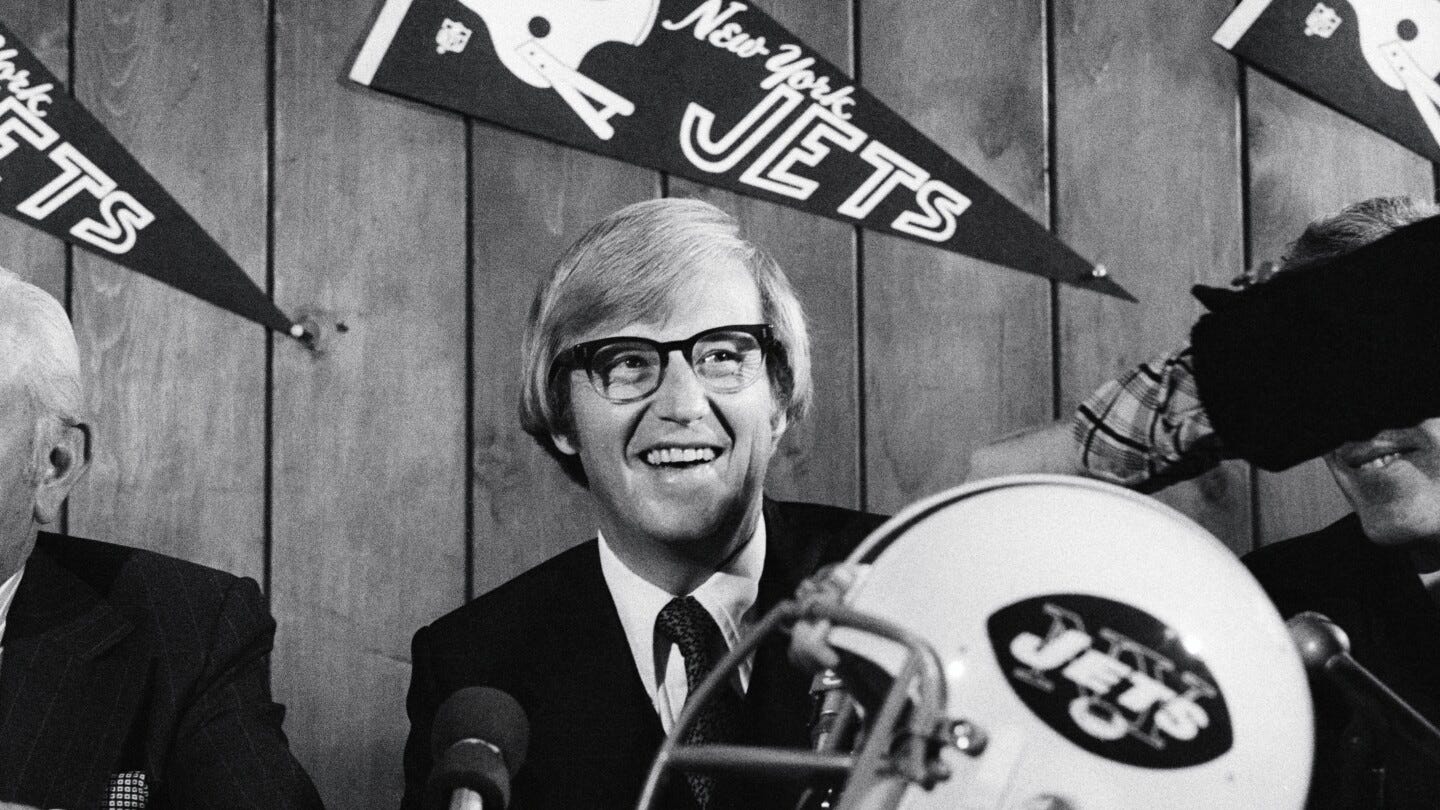
In 1976, a small man with a strange haircut became the head coach of the New York Jets. Lou Holtz was 39 years old, ambitious and energetic and witty and perpetually yearning for a challenge. He spit out one-liners and smoked a pipe and performed magic tricks as a way of balancing out his obsessive coaching persona; he was half Kermit the Frog and half Woody Hayes, with a haircut straight out of a medieval comic strip. For whatever reason, he thought he could import that folksiness to a professional franchise in the most cynical big city on earth.
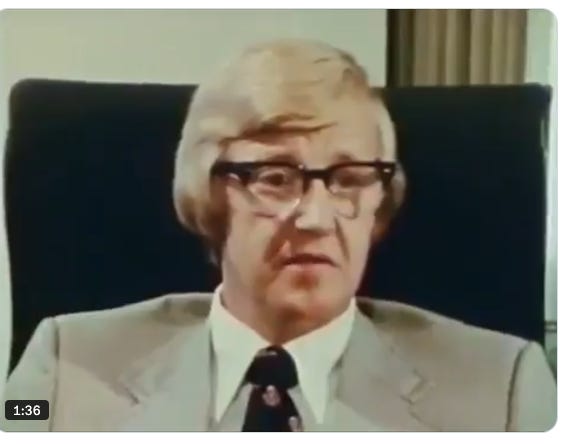
“I don’t think that an athlete in college is an easy or more difficult to motivate than one in the pros,” Holtz said, and for the next several months, he would go about attempting to prove that he actually believed what he said, even though he didn’t really believe it at all. Holtz’s biggest impact during his short tenure in the NFL was a rather simple idea: He invited his draft picks and rookie free agents to the team’s headquarters on Long Island for a four-day orientation camp that was essentially a way to measure if they were actually any good. (That eventually inspired the notion that every team should be evaluating talent up close in a controlled environment, which helped bring about the NFL combine.)
Beyond that, Holtz was completely wrong for the job. It is hard to imagine someone who had less in common with an aging Joe Namath; it is hard to imagine a coach who inserted himself into the wrong city and the wrong franchise more definitively than Holtz. The first time Holtz tried to call Namath, he was told he’d have to go through his agent. At one point, Holtz wrote the Jets a team song that no one wanted to sing. The Jets had gone 3-11 the year before, and with the Jets marooned at 3-10 in 1976, Holtz decided he couldn’t do this job for another game, let alone for the four years remaining on his contract. He did not belong here, either in New York City or in professional football. He found a lifeline and took a job as the head coach at the University of Arkansas. He’d made a mistake, and to his credit, he was willing to admit it.
“I don’t care how you twist it or how you turn it,” he said. “Lou Holtz is not made for professional football.”
II.
There was nothing remotely cool about Lou Holtz, who died this week at the age of 89. What made him fascinating is that he didn’t care. His folksiness enabled him to put a presentable face on his pathological competitiveness; he made jokes about his size and his looks and his Sylvester the Cat lisp, and described his body as “looking like I’ve had beriberi and scurvy.” His one-liners were legitimately funny, in a Henny Youngman kind of way:
—My doctor told me I’ll have this cold all season, but if I can get a little sicker and it turns into pneumonia, he’ll able to cure that.
—I can throw a clipboard as good as any coach who’s 6-4.
—When people ask me how I’m doing, I say, ‘I’m one step on the right side of suicide and two steps ahead of the posse.’”
Instead of frightening reporters, Holtz mostly just charmed them. Even in New York, his brief tenure was largely dismissed as a mistake, a square peg-round hole scenario that could be attributed to the ineptitude of the Jets ownership as much as Holtz himself.
For years, Holtz was one of those restless souls who seemed unable to hold down a job for very long without growing antsy or alienating his bosses. In 1966, when he was nearing his 30th birthday, he created a bucket list of 107 things he wanted to do before he died, which included skydiving, winning a national championship, and coaching at Notre Dame. He spent a year coaching under Woody Hayes when Ohio State won the national championship in 1968, had three losing seasons at William and Mary (where he famously joked they had too many Marys and not enough Williams), then went to N.C. State, and then to the Jets, and then to Arkansas, where he went 30-5-1 in his first three seasons.
Over time, Holtz slowly alienated both his bosses at Arkansas and the fan base. He increasingly directed his passions elsewhere. In 1983, he cut a campaign ad for the segregationist senator Jesse Helms in his own office on campus, in the midst of Helms’ insistence that Martin Luther King Jr. did not deserve a national holiday. That was enough to finally force Holtz out the door. He spent two seasons in Minnesota and then his dream job tumbled into his lap: Notre Dame pulled the plug after a failed five-year experiment with a high-school football coach named Gerry Faust, and offered the job to Holtz. And no one since Knute Rockne had been constructed for the Notre Dame job quite like Lou Holtz.
III.
It was not in my nature to like Lou Holtz, in large part because I came of age in State College, Pennsylvania, at a moment when one of the best college football rivalries of the 1980s was the one between Penn State and Notre Dame. In a way, Holtz was the bizarro version of Joe Paterno, a guy who was genetically constructed to coach college football and preached all the right things about college football and yet was inherently drawn in to the compromises of a sport that often exploited its talent and rewarded successful coaches with a tremendous amount of power.
But I hadn’t really thought through any of that then. I just knew that Notre Dame was good, and Penn State was also good, and you had to choose one or the other. Between 1986—when Holtz took the job at Notre Dame—and the end of the series in 1992, Penn State won four times and Notre Dame won three. Holtz went 12-0 in 1988 and won a national championship; in 1989, Notre Dame went 12-1 and finished second in the final Associated Press poll.
Both Penn State and Notre Dame sold themselves as the embodiment of college football’s enduring myth, in contrast to rogue programs like Miami and Oklahoma. In a 1989 Sports Illustrated profile of Holtz—published two years after the magazine had named Paterno its Sportsman of the Year—one Notre Dame administrator told SI, “We do not alter the philosophy of the university for athletics. Everything we do must be a reflection of our primary mission, which is preparing our students to serve society and the church.” And back then, a lot of us were naive enough to still believe such things were unambiguously true.
IV.
Like Paterno, Holtz was the ideal figurehead for a program that trafficked on its own mythology. He refocused the program on an image; he was a college football coach, through and through, a guy who spoke in public with the wit of Will Rogers and competed behind the scenes with the fury of Richard Nixon. Even if that image was actually masking certain transgressions, it enabled Notre Dame to become Notre Dame again, in the last era where a power dynamic like that between coach and player could exist without making people wonder whether it ever should have existed in the first place.
For years after he retired, Holtz imported his persona to ESPN, where he became the voice of a fading era of college football where the coach was the center of everything. He played the character of “Dr. Lou,” a pseudo-psychiatrist who espoused folksy advice in dusty aphorisms, and he advocated for a nostalgic view of the world that led him straight into the arms of the current president of the United States.
Holtz once joked that if you wanted to know how much a man would be lamented when he was gone, all he had to do was reach his hand into a bucket of water and then pull it back out. “The size of the hole he leaves,” Holtz said, “is how much he’ll be missed.” But there was more to him that that. For a time, in the post-Watergate era, Holtz filled a hole in college football. And then as the college game and professional game slowly converged, Holtz felt increasingly like a relic of a bygone era, of a time when the sports had two completely distinct identities, both for better and for worse.
There are still a handful of college football coaches who feel like they were born to be college football coaches, but it’s different now (and arguably a little bit more honest). You might argue that Lou Holtz was the bridge. He was often an imperfect messenger, but he was one of the last coaches who sold us on the promise of college football before college football became something altogether different.
This newsletter is a perpetual work in progress. Thoughts? Ideas for future editions? Respond to this newsletter, Contact me via twitter or at michaeliweinreb at gmail, or leave a comment below. If you enjoyed this newsletter, please join the list and/or share it with one or two people you know.
Arkansas fans threw oranges on the field when the team clinched an Orange Bowl berth which prompted to Holtz to say "I'm glad we're not going to the Gator Bowl." Upon taking the Minnesota job, he said " his team would play with the heart and soul of Minnesotans unfortunately, they have to go elsewhere for the arms and legs." He was also a Jesse Helms supporter. 'Nuff said.
Both Lou Holtz and I arrived from out-of-state to the University of South Carolina in 1999 and we both left in 2004. I can say with certainty nobody contributed more to creating a memorable experience while a Carolina student than Coach Lou Holtz, even if we only shared a brief encounter.
It was Sept. 2000. Carolina had just beat Miss. State on a last-second TD lob from our backup QB. I was fortunate enough to be a student worker for the Gamecock Club, standing in the tunnel in the opposite corner of that endzone. The stadium was pure pandemonium. We were maybe 3-0 after this SEC win. Coming off an embarrassing historic 21-game losing streak stretching the previous two seasons and shocking Georgia the week before, there was reason for excitement.
After the game, I was walking around the bowels of the stadium, when I saw him standing outside of the victorious team's locker room. Holtz was wearing a garnet Carolina pullover and smoking a pipe. "Hey Coach! Great win!" I gushed. He may have mumbled something in my direction, but I don't recall. It was one of the Forestt Gump-like encounters that I will never forget.
Maybe I am biased, but I'd say taking up from 0-11 in 1999 to back-to-back bowl wins over Ohio State is as impress as anything he did with Notre Dame.
Thanks for the memories, coach.