
Kasparov's Last Stand (1996)
Thirty years after a computer first beat the world's best chess player, we're still trying to figure out what it means.

This is Throwbacks, a newsletter by me, Michael Weinreb, about sports, history, culture, and politics—and how they all bleed together.
If you like what you read, please click the button below, join the mailing list for FREE. And if you’ve been reading for a while, please consider joining the list of paid subscribers to unlock paid posts and allow me to expand Throwbacks’ offerings, and please share it with one or two people you know.
Here’s a link to get 20 percent off a monthly membership for your first year:
And here’s link to get 25 percent off an annual membership:
(If you cannot afford a paid subscription and would like one, send me an email and I’ll comp you one, no questions asked.)
I.
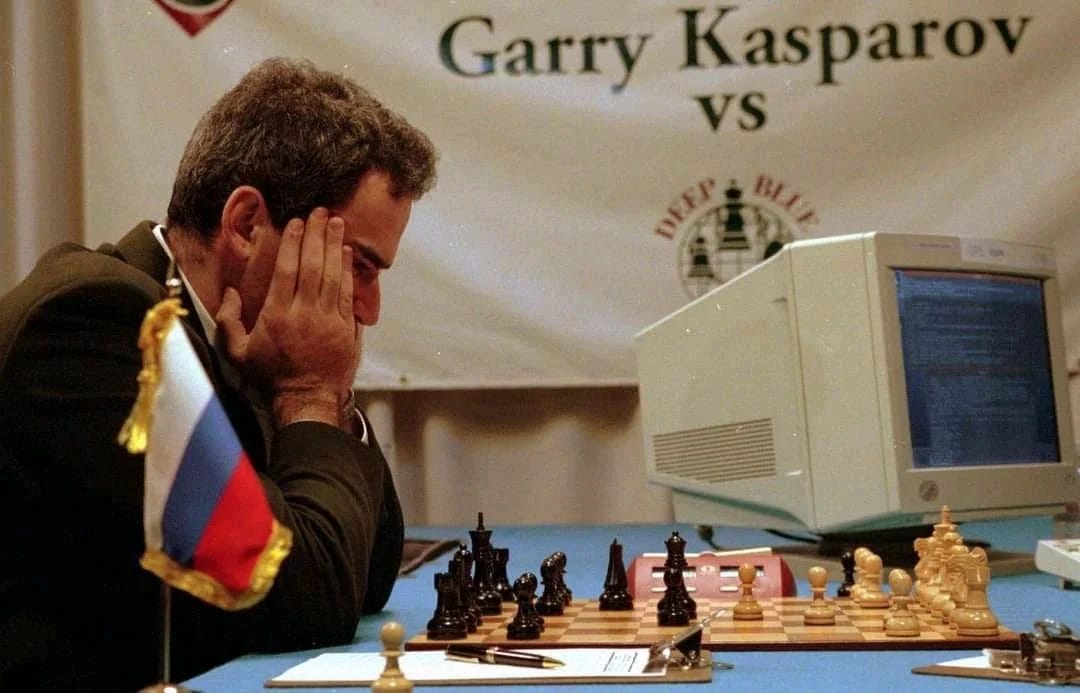
Garry Kasparov presumed he possessed an inherent advantage based on one central fact: He was a human being, and his opponent was not. It was February 1996, thirty years before AI engines would be embraced by strangely robotic CEOs while tapping into a deep well of societal anxiety. Kasparov felt the burden of defending humanity against the coming flood, but he also thought the task before him was eminently doable. He was 32 years old, and he was one of the best chess players the world had ever known. He believed he could see and process the board in a way a computer never could, even if that computer was an IBM-designed “monster” known as Deep Blue, capable of processing two hundred million moves per second. So he sat down at the table buoyed by what in retrospect feels like a surprising level of self-confidence.
And then the computer made its first play with the white pieces. A pawn sacrifice. The kind of thing a human would do. A computer, he thought, would never make such a move. Kasparov was stunned. This computer was not like the other more primitive computers he had played against; this computer was capable of co-opting the input it had been given and making decisions that almost felt human. It acted without hesitation; it attacked relentlessly. It was clear to Kasparov that a new kind of artificial intelligence had been born that day.
And yet Kasparov understood where Deep Blue’s weaknesses lay. The thing that would confuse Deep Blue, he soon realized, was to embrace the unpredictability of humanity itself. Don’t play to the algorithm; make the algorithm chase you.
In a subsequent game, Kasparov changed the order of a well-known opening sequence. Deep Blue, unable to tap into its well of data, found itself lost. Kasparov could figure out the computer, but the computer couldn’t figure out Kasparov. He played completely unorthodox chess, and he won his match against Deep Blue, four games to two. “It’s a weird kind (of intelligence), an inefficient, inflexible kind,” Kasparov wrote, “that makes me think I have a few years left.”
It would not take that long: A year later, in 1997 (the same year one of the best-ever dystopian science-fiction movies about the perils of AI was released into theaters), Kasparov would lose the rematch against Deep Blue. And perhaps because of that—perhaps because we’d witnessed such a stark example of computing power simply overwhelming humanity itself—it felt as if we began to believe that humanity was inevitably doomed to a position of inferiority.
II.
Here is a thirty-second commercial for Microsoft’s Co-Pilot AI engine that aired during the Super Bowl:
This is, of course, an absurd advertisement. It is so absurd, in fact, that it gives you hope that humanity still has a few years left.
