
How We Killed The NCAA Tournament Bracket
One of the most joyful pastimes in sports isn't really that fun anymore.

This is Throwbacks, a newsletter by me, Michael Weinreb, about sports, history, culture, and politics—and how they all bleed together.
If you like what you read, please click the button below, join the mailing list for FREE. And if you’ve been reading for a while, please consider joining the list of paid subscribers to unlock paid posts and allow me to expand Throwbacks’ offerings, and please share it with one or two people you know.
Here’s a link to get 25 percent off an annual membership for a limited time:
(If you cannot afford a paid subscription and would like one, send me an email and I’ll comp you one, no questions asked.)
I.
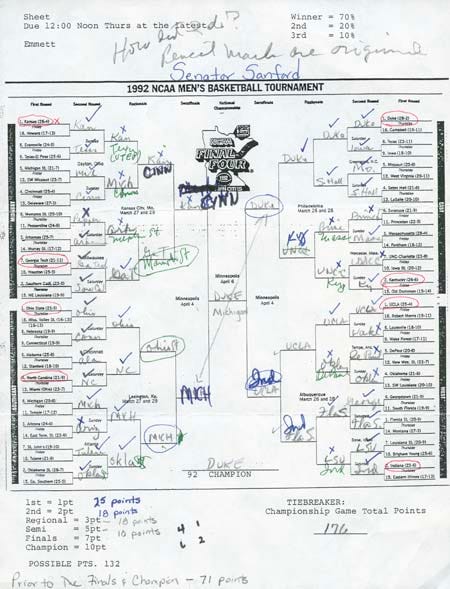
Sometimes the big idea lands in two places at once. The Internet tells me this is called “multiple discovery,” and it appears this is what occurred in that seminal era between 1977 and 1978, when a postal worker in Louisville and a bar owner in Staten Island happened upon the same invention at nearly the same moment. From there, it spread outward and became the guiding force of every March to come, until the idea of filling out a bracket that predicted the winner of every game of the NCAA tournament became a more potent idea than the tournament itself.
The postal worker in Louisville was a man named Bob Stinson, who apparently came up with the idea by looking at the bracket of his recreational-league softball tournament. He drew his brackets using a ruler and unlined paper, and perhaps most important, he charged a nominal entry fee. The idea of the NCAA tournament pool was not about making any real money; the idea of the NCAA tournament pool was to heighten the excitement and sheer unpredictability of the NCAA tournament itself. “It was kind of a betting thing but not really,” Stinson’s son Damon told the Associated Press. “It was kind of a who-knows-college-basketball-better kind of thing.”
For a long time, the bracket really did feel like that kind of thing. There was a low-stakes simplicity to it, a sense that anything was possible in a tournament where upsets were the norm. For many of us, it was the only kind of real wagering we would have access to all year long, and that was exciting in itself. Damon Stinson nearly got thrown out of his Catholic school for peddling brackets to fellow students for ten bucks each and for carrying 350 bucks in his backpack; I remember dodging the upright teachers and swearing the hip ones to silence in the hallway of my high school when I ran my own pool in the 10th grade.
That’s what the bracket was: It was an open secret that pissed off the upright sticklers and appealed to those of us who enjoyed casually breaking the rules. It enhanced the tournament for people who might not otherwise watch, and made those of us who actually watched college basketball realize that we didn’t know a goddamn thing about anything. It was an easy way for young people obsessed with sports to learn the lesson that gambling was mostly futile and stupid. The people who won the pool were often the ones who chose teams based on where their second cousin’s sister went to college and which canine mascots felt most noble. But that fun has largely been drained from the bracket, in large part because we live in a different world now.
We live in a world where gambling literally props up the business of sports, and where the speed and ubiquity of that ability to gamble has become distasteful even to the people who kind of enjoy gambling. We live in a world where the bracket now feels like just another commoditized element of a business that is in our faces during every commercial break and on every single podcast. And I assume this is why, as someone who once risked detention to proliferate the bracket, I find that filling out a bracket doesn’t bring me much joy at all anymore.

II.
I suppose you could argue that part of the thrill of the bracket is that it existed in that quasi-legal universe where everyone knew it was “gambling” but no one particularly cared because the gambling was generally so harmless. It was the cultural equivalent of smoking a joint under the stands of the high-school football stadium. The only time it became a problem was when it got too big and got too much publicity—when it felt as if the secret had been whispered too loudly. This is what happened at Jody’s Club Forest, a bar on Staten Island that invented its own iteration of the bracket pool right around the same time Bob Stinson invented his. “The pool was essentially a mom-and-pop business,” the Associated Press wrote, “and it took days in its beginning in an era without fast and reliable computers to enter all the picks.”
For three decades, Jody’s kept its pool going, but it got bigger and bigger. It became such an open secret that Sports Illustrated wrote about it, and eventually the whispers grew so loud that they could no longer be contained.
