
"A Palpably Unfair Act" (1969)
How rules get made in sports (and beyond), and why the Tush Push is next.

This is Throwbacks, a newsletter by me, Michael Weinreb, about sports, history, culture and politics, and everything in-between. Welcome to all new readers/subscribers, and if you like what you’re reading, please join the mailing list and share, on social media or through e-mail or however you feel comfortable sharing. (It’s still FREE to join the list: Just click “None” on the “subscribe now” page.) The best way you can help out is by spreading the word and sharing with others. I have set up payment tiers, if you wish to chip in and allow me the time to do a little more research on on these posts. You’ll get full access to the archive of more than 100 previous posts, as well.
I.
Let us begin today with an esoteric piece of trivia that I promise will become relevant in just a moment: With the 76th pick of the 1969 NFL/AFL Draft, the Kansas City Chiefs selected Morris Stroud, out of Clark Atlanta University.
Stroud was not exactly a conventional choice. He was a 6-foot-10 center on the basketball team of a small HBCU who didn’t play football his senior season due to academic issues. But the Chiefs locked in on Morris Stroud anyhow, and Stroud was so genuinely excited to get the call from the Chiefs that he hung up and spent a dollar’s worth of dimes on the pay phone at his dorm, calling up pretty much everyone he could think of to tell them the impossible had happened.
The Chiefs had an ulterior motive for drafting Stroud, beyond his potential as a tight end (and he was not a bad tight end at all, catching 54 passes over the course of five seasons). The Chiefs drafted Morris Stroud in part because he was very tall—he is, in fact, still one of the tallest players ever to play professional football—and because Chiefs coach Hank Stram had another idea how to use Stroud’s height to his advantage. When an opposing team lined up to kick a field goal, Stroud would station himself near the goalpost, leap in the air, and attempt to deflect the ball away. (You can see Stroud’s futile attempt to block George Blanda’s game-winning kick here. I would link it directly here, but I cannot, because of Elon’s petty grudges.)
This was a legal play in the AFL at the time. But eventually, after the NFL and AFL merged, it was outlawed; the NFL passed a clause in Rule 12, Section 3, Article 1, which literally outlawed goaltending in football—and declares, in part, that the referee may “award 3 points for a palpably unfair act.” It became known, informally, as “the Stroud rule,” and when Stroud died in 2016, that rule was included in the first line of his obituary.
This is generally how rules are made in sports (and even beyond sports): Someone—an individual, a team, a coach—finds a loophole in the rulebook, exploits it for a brief period of time, and the loophole gets fixed. But this is 2023, and contempt for modern institutions runs high, so I guess it’s not surprising that a lot of people believe this kind of rule-making should no longer apply at all.
II.
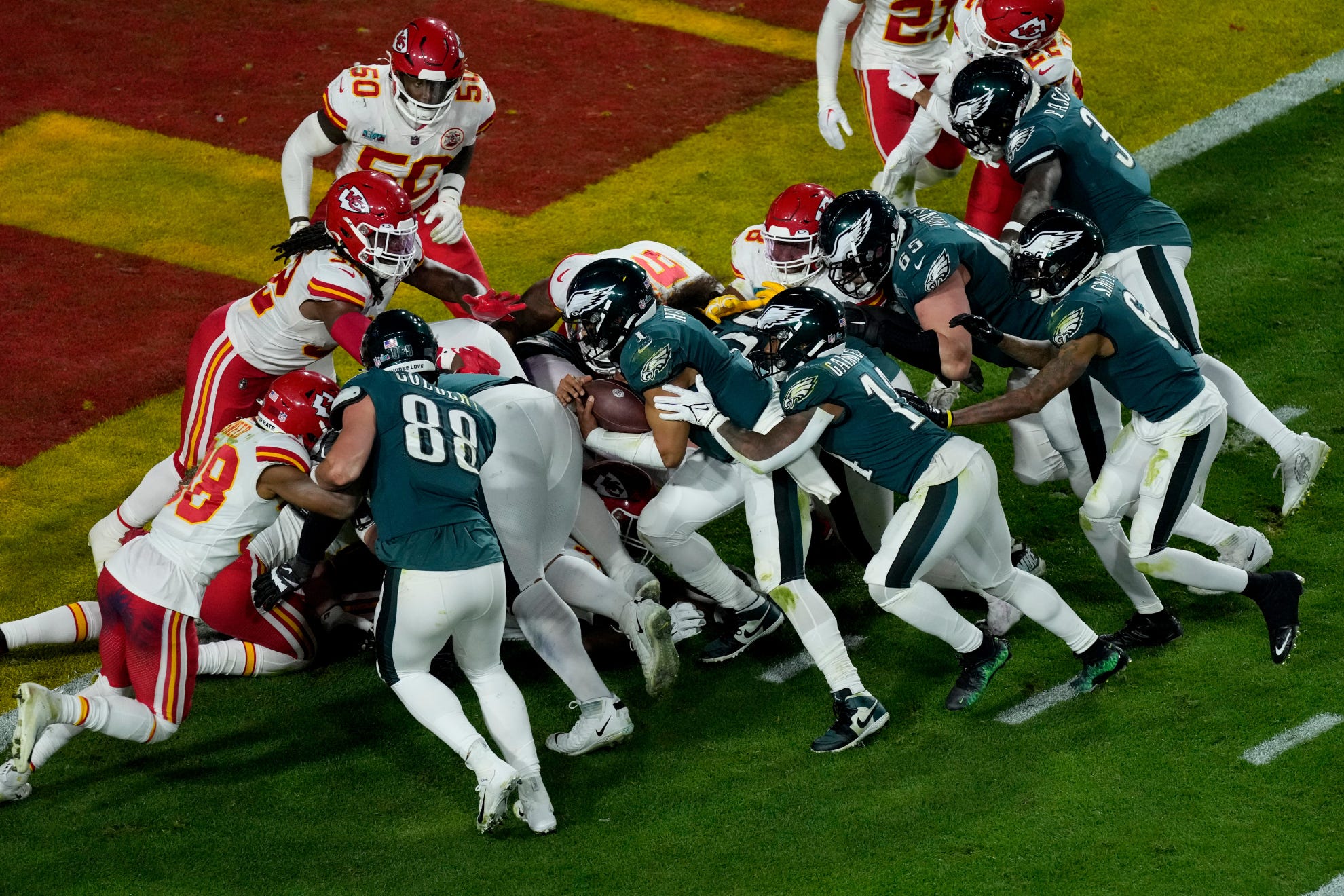
I mean, just step back from the present with me for a moment and into the late 1800s, when so-called “mass momentum plays” rendered college football a violent and untenable slog. And then take one look at what the Philadelphia Eagles are doing and tell me it doesn’t comport with the same brutish principles:
They call it the “Tush Push,” or the “Brotherly Shove.” The former nickname—inspired by a college football play that pretty much everyone agrees was unfair—should be your first clue that this everyone knows this play is totally shady. And the latter nickname, an ironic allusion to Philadelphia’s ironic sobriquet, should give you enough of an understanding as to why this play should clearly be eliminated from football: Because one team has found a loophole in the rules, and is exploiting it, over and over again, in crucial game situations.
Yet because we live in an era where people will argue in favor of literally anything, the Tush Push is not viewed as something that should obviously be outlawed. Instead, it is regarded as “controversial.” And it’s even snookered otherwise smart people like Yahoo’s Dan Wetzel, arguably the best sports columnist in America.
“If everyone could, they would,” Wetzel writes of the Tush Push. But because only the Eagles can execute it to perfection, Wetzel argues, the NFL shouldn’t do anything about it at all. “Until everyone can — and the game of football is fundamentally and forever changed,” Wetzel writes, “then the NFL shouldn’t even consider changing the rule.”
I’m sorry, Dan, but what the hell? Because that’s certainly not the way history has worked.
In every single American sport, dozens of rules have been altered because of the tactics of a single athlete or franchise. Dominance is not an excuse; dominance is very often the reason why rules are changed, like when the NBA widened the lane to make things more difficult for George Mikan and Wilt Chamberlain, and or when Major League Baseball lowered the pitchers’ mound because of the sheer dominance of Bob Gibson. This is what sports are; they are living, breathing organisms, constantly falling out of balance and back into balance, and to deny that is as idiotic as claiming that a founding document written in 1787 should not evolve to reflect the whims of a changing society.
III.
Look, I certainly sympathize with the principle of challenging unjust laws. And I applaud the Eagles’ resourcefulness, just as I admire the ingenuity of Hank Stram and Morris Stroud all those years ago. It’s a good thing to question the rules. But even on a microcosmal level, banning the Tush Push would not prove some grave injustice; it would not hurt football at all. This is a tiresome (and potentially dangerous) tactic that clearly violates the spirit of what the sport is supposed to be ever since those mass-momentum plays were banned in the 1800s. It brings no one joy except Eagles fans, who wouldn’t know what to do with joy if it dropped a truckload of Evereadys on their heads while wearing a Santa Claus suit.

Perhaps not coincidentally, the other big story in football this week was Michigan coach Jim Harbaugh’s blatant subversion of the rules in order to steal the same signs that he appeared capable of stealing under the rules as they currently stand. And the initial reaction to this seemed to be: Who cares?
To which I say: Are we so far gone that we don’t even care if someone violates rules for no other reason than because he can? I don’t want to live in a society where the only way to alter the rules is to wait until literally everyone is doing it, because by then, it’s too late. We know what’s just and unjust; we just don’t seem to care very much anymore if it affects the particular team we root for. And that’s how America got into this mess in the first place.
This newsletter is a perpetual work in progress. Thoughts? Ideas for future editions? Reply directly to this newsletter, contact me via twitter or at michaeliweinreb at gmail, or leave a comment below. If you enjoyed this newsletter, please join the list and/or share it with others or consider a paid subscription.
Bravo, Michael!! Are we so in love with innovation that we are blind to whether it is unfair, unjust or just plain wrong?
The “Stroud Rule” — the NFL’s version of the basketball goaltending rule — is notable for being a particularly gratuitous intervention, among those rule reforms that have been instituted by NFL sticks-in-the-mud feverishly scrambling to kill any signs of quirky innovations in the play of the game. One •can• understand the notion that there are features of a sport that are essential to its nature . . . and that from time to time someone will come up with some excessively gimmicky way to circumvent or defeat those features. When that happens, it’s reasonable to amend the rules of the game to outlaw those gimmicks. To cite some old and really basic examples, that’s why football players are forbidden to hide the ball under their jerseys, or to sew on to their jerseys padded extensions that •look• like footballs (to confuse the defense). Back in the late 1800s, some teams actually tried those things, and the rules were, appropriately, amended to dispense with such nonsense.
But what does the field-goal goaltending rule prevent? How many field goal attempts are actually blockable at the crossbar by a player leaping up from the ground below?! Seriously, that sort of block attempt would threaten •only• those kicks that cleared the crossbar (10 feet off the ground, of course) by less than about two feet. In other words, the Stroud Rule protects only a vanishingly small number of field goal attempts.
Indeed, as far as I can tell, before the advent of the Stroud Rule (sometime in the 1970s or ’80s?), only •one• NFL field goal attempt was ever blocked at the crossbar. On 8 December 1962, the Baltimore Colts wide receiver R.C. Owens turned the trick. In Baltimore’s 34–21 win over Washington, in Baltimore, Owens successfully deflected a first-quarter 40-yard field goal attempt by Washington‘s Bob Khayat, just before it could pass over the crossbar. (See Press and Sun-Bulletin (Binghamton, NY), p. 9 (Sun., 9 Dec. 1962) (with photo); Ted Patterson, Football in Baltimore: History and Memorabilia, p. 170 (Baltimore, London: The Johns Hopkins University Press, 2000).)
Owens then picked up the ball near the goal line — the goal posts were, before 1974, on the goal line, rather than the end line, and it was still a live ball after Owens blocked it — and ran it out to about the 15, where he was tackled by Washington’s Ben Davidson. Again, it does not appear that Owens, or any other player (Stroud included) ever made another such successful at-the-crossbar block. I think it is manifestly clear that the Stroud Rule stands as a silly waste of effort attempting to correct a non-existent problem!
But, interestingly, I do remember seeing Stroud himself attempt to block a field goal at the crossbar. The main article, above, links a video clip that includes that moment — on 1 Nov. 1970, as Stroud leapt in vain for the 43-year old George Blanda’s 48-yard field goal attempt. There were 8 seconds left in the game, and Blanda’s kick sailed just over Stroud’s fingertips, pulling visiting Oakland into a 17-17 tie with Kansas City. The Chiefs were defending Super Bowl champions, but that tie ultimately cost KC the AFC West Division title, and kept them out of the playoffs in 1970.
And Oakland got the chance to make that field goal because a couple minutes earlier, a run by KC’s QB Len Dawson for a first down had been wiped out, when, down and out of bounds, two seconds after the whistle, he was speared, and enraged KC players retaliated at the blatant cheap shot. With a first down, KC could have run out the clock. But the bench-clearing mêlée resulted in offsetting dead-ball penalties that, under the rules at the time, wiped out the previous play and the KC first down. Replaying the down, KC failed, that time, to make a first down. The Chiefs had to punt. Oakland drove past midfield, and got just close enough for Blanda to make a field goal and salvage a tie.
And, the Raider who speared Dawson with the late hit, sparked the brawl, wiped out KC’s first down, set the stage for Blanda’s field goal, and for Stroud’s barely-missed attempt to block the kick at the crossbar . . . was Big Ben Davidson — the same Ben Davidson who had tackled Baltimore’s R.C. Owens back in 1962, when he •did• block a field goal attempt at the crossbar, and was returning the kick.