
Big Fish (1996)
The cult of Deion.

This is Throwbacks, a newsletter by me, Michael Weinreb, about sports, history, culture and politics, and everything in-between. Welcome to all new readers/subscribers, and if you like what you’re reading, please join the mailing list and share, on social media or through e-mail or however you feel comfortable sharing. (It’s still FREE to join the list: Just click “None” on the “subscribe now” page.) The best way you can help out is by spreading the word and sharing with others. I have set up payment tiers, if you wish to chip in and allow me the time to do a little more research on on these posts and have full access to the archives—I’ve made those subscriptions about as cheap as Substack will let me make them, which is $5 a month or $40 a year.
I.
Let’s start with a fish story, and because this is Deion Sanders we’re talking about, it is a one hell of a fish story. It goes back to 1996, when the most immoderate athlete of his generation flew into his hometown of Fort Myers, Florida, and decided to take a detour to a small pond near the airport so he could find out if the fish were biting. This was not the first time Deion had taken to this body of water; he’d already been issued one verbal warning for encroaching on county-owned territory, and then been given a written warning the month before for doing the same thing again. But Deion did not take to the warnings any more than he took to that large NO TRESPASSING sign in front of the lake, because Deion has never really played by traditional rules.
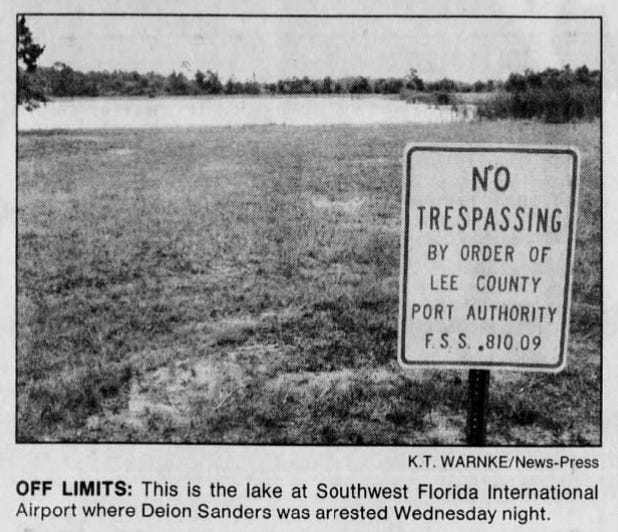
And so Deion and his friend set out in a fishing boat that day. And the bass were really biting, which is probably not surprising, given that pretty much no one else had the audacity to actually fish in this lake. According to Deion, he caught one fish after another, and when the port authority cops showed up and summoned him ashore, Deion kept fishing, because damn, the fish just kept coming, and the cops could wait for a few more casts. Deion claimed to catch ten fish that day, and then, finally, on his own time, he rowed ashore, to the consternation of the authorities. The police slipped a pair of handcuffs onto Deion’s wrists, drove him to headquarters, and took Deion’s mugshot, which looked like this:
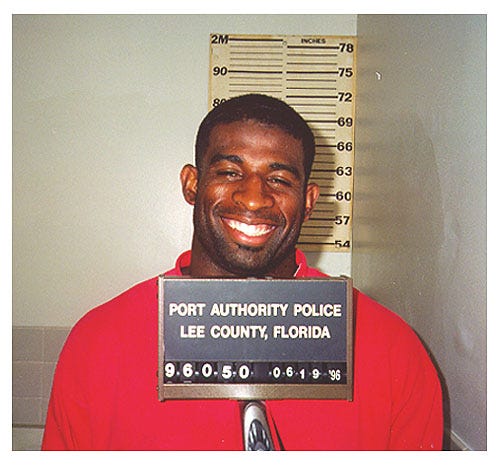
Such is the essence of Deion Sanders. He saw a lake stocked with fish just sitting there for the taking and thought to himself, “Why shouldn’t I be the one to take it?” And when he got caught, he found it utterly absurd.
In a way, Deion was right to mock the seriousness of the situation, because on the very same day in June of 1996 that the story of Deion’s arrest appeared on the front page of the Fort-Myers News Press, another story ran right next to it, about a Fort Myers police officer who’d been arrested on a rape charge. How, he wondered, could anyone liken a bit of illicit outdoor recreation with an actual crime?
“I don’t call that trouble,” Deion told reporters. “Deion Sanders is not associated with drugs, alcohol, violence. I was fishing.”
II.
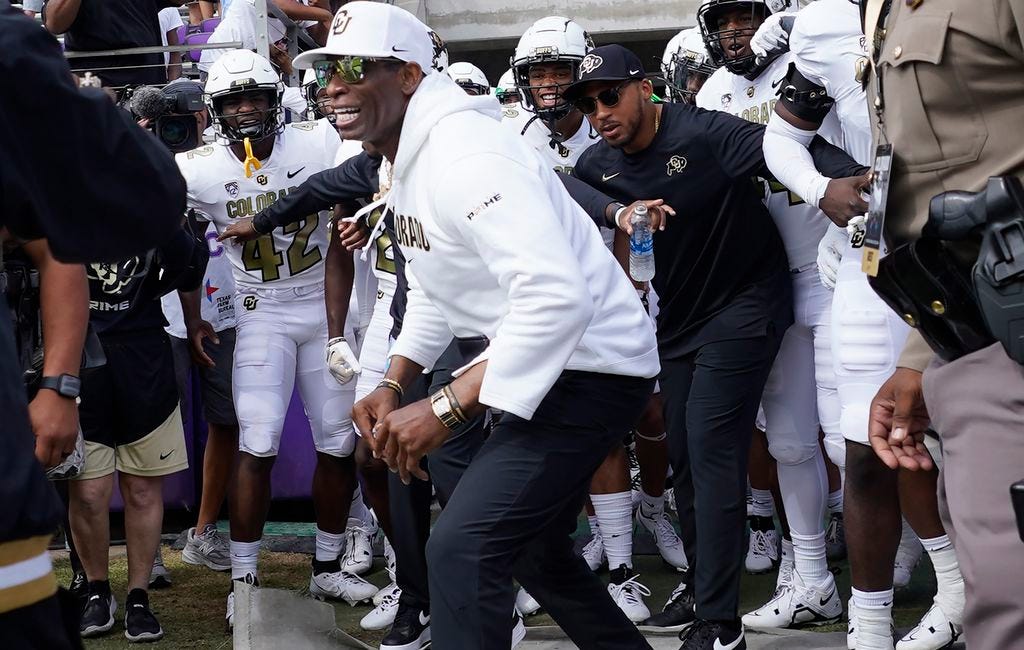
Twenty-seven years later, Deion Sander—after defeating TCU in his first game as the head coach at the University of Colorado—is the biggest story in college football. And how you feel about what Deion Sanders is doing right now—the way he’s flaunted the humble tropes of college sports by declaring from day one of his hire that he was going to start his own son at quarterback, and the way he unapologetically turned over the previous Colorado roster by dismissing nearly everyone who played for the Buffaloes last season, and the way he talks openly about his players winning Heisman Trophies after a single half of football, and the way he plays veteran reporters like string instruments—is likely grounded in how you’ve viewed Deion Sanders for the past 35 years. Because he’s always been fishing: For attention, for success, for self-aggrandizement, for the recognition that comes from being a born provocateur who refuses to adhere to staid traditions.
Back when Deion was in college at Florida State in the late 1980s, he had an almost preternatural grasp of the changing nature of celebrity. This was an era when television and a 24-hour news cycle driven largely by ESPN had begun to transform athletes into mythological figures. But instead of going the Bo Jackson route and shrouding himself in mysticism, and instead of going the Michael Jordan route and embracing a gauzy and untouchable brand of celebrity, Deion threaded the needle and became something altogether new. He was Deion, but he was also “Prime Time,” a shrewdly crafted public character who both embraced and defied stereotypes.
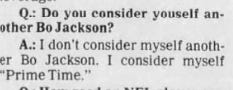
He used reporters to boost his notoriety, and they used him because he gave them a good quote every single time. He wore thousands of dollars worth of gold and jewelry, he said, because “I like little kids to see it and say, ‘He wears all this jewelry and dresses nice and he’s not a drug dealer.” He freely admitted he wasn’t at Florida State to go to school, but to prepare himself to make a hell of a lot of money. He trespassed into a thicket of racial and cultural stereotypes, and was so supremely talented and supremely self-confident that he emerged entirely as himself.
Even now, it’s hard to know for a neutral observer to know what the hell to do with Deion Sanders. He veers from annoying to amusing, often in the course of a single sentence. His son, like his father, is a mesmerizing athlete with an incredibly high ceiling as a quarterback, and the two-way athlete he brought with him from his previous coaching job at Jackson State, Travis Hunter, is molding himself in Deion’s image as someone who completely defies expectation. He makes things fun, even when he’s insufferable.
I, too, am of mixed mind about Deion. The fusty side of me despises that this is happening now, because the last thing we need is for another performative egotist to triumph in an era replete with demagogues. But the contrarian half of me wants Deion to keep going, and for Colorado to keep winning, largely because he is a maverick, a trickster who knows exactly how to push the right buttons, and by doing so, make us question our cultural assumptions.
That day in Fort Myers in 1996, the police let Deion keep all the fish he caught, because by then, what was the point in throwing them back? “I had a great time,” he told reporters, and then he sat there for a while longer, as those journalists tried like hell to wipe the smile off his face with pointed questions about his place as a role model, and completely failed to do so.
This newsletter is a perpetual work in progress. Thoughts? Ideas for future editions? Reply directly to this newsletter, contact me via twitter or at michaeliweinreb at gmail, or leave a comment below. If you enjoyed this newsletter, please join the list and/or share it with others or consider a paid subscription.