
Sorry, But Baseball Is Not Doing Fine
Three decades after 1994, the sport still can't figure out how to embrace the collective good.

This is Throwbacks, a newsletter by me, Michael Weinreb, about sports, history, culture, and politics—and how they all bleed together.
If you like what you read, please click the button below, join the mailing list for FREE. And if you’ve been reading for a while, please consider joining the list of paid subscribers to unlock weekly paid posts and allow me to expand Throwbacks’ offerings. And please share it with one or two people you know.
Here’s a link to get 20 percent off a monthly or yearly subscription:
I.
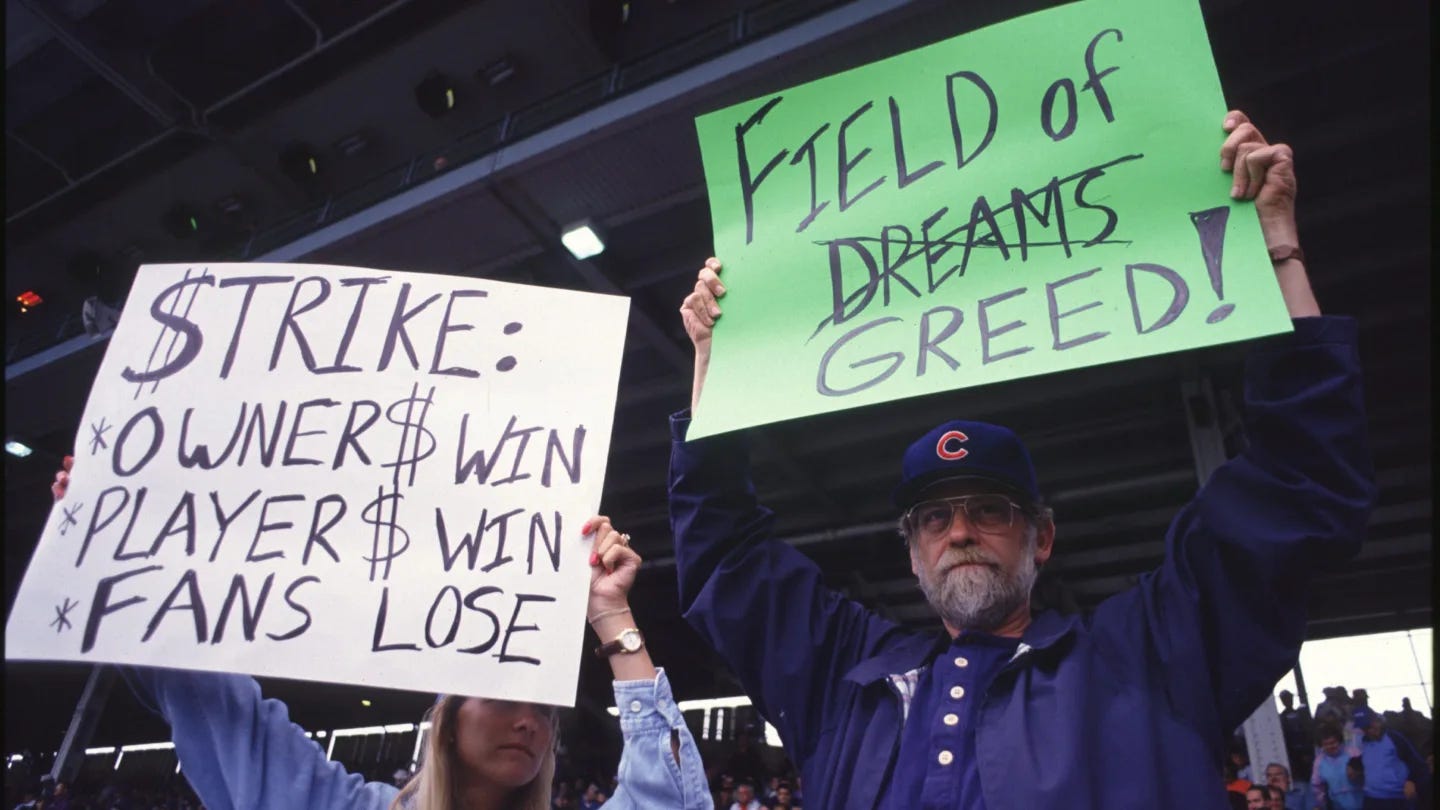
On the last day of the golden era of Major League Baseball in America, a lawyer for the Major League Baseball Players Association named Donald Fehr rushed out of Yankee Stadium, trailed by a small army of reporters and television cameras. As Fehr hurried to a waiting taxicab and sped off into the worst imaginable future, a man dressed as a clown and inexplicably hauling a bucket appeared as if from out of nowhere on the streets of the Bronx. “Kiss and make up!” the clown shouted. “Kiss and make up! Don’t kick the bucket!”
It was August 11, 1994, and even without the clown (I don’t think it was Bill Murray, but who knows), this was arguably the weirdest and most depressing day in baseball history, or at least since Shoeless Joe Jackson emerged from a courthouse. Here was a sport in the midst of one of its greatest seasons in recent memory: The Yankees, after years of ignominy, were back in first place in the American League East, and the Montreal Expos were on the verge of saving baseball in their own city, and Tony Gwynn was hitting .394 for the San Diego Padres, and the Giants’ Matt Williams had already hit 43 home runs and was on pace to break Roger Maris’s single-season record. And the whole thing was about to be sabotaged because the players refused to accede to anything resembling a salary cap, and the owners—who, at that point, refused to even appoint a commissioner until the negotiations were complete— declined to budge on their demands. There was, at that moment, no sense among either side that the game mattered more than they did; there was no sense that the best way to keep growing baseball, and to keep it relevant, was to broker some kind of compromise, even if they despised each other.
“For us kids,” said Stephen Vogt, who was 9 years old at the time, and would eventually become a Major League catcher and manager, “the not understanding part was the hardest part.”
The work stoppage began on August 12. Years earlier, back in 1970, Bud Selig—a kind of de facto commissioner in 1994—had noted the pure vitriol between labor and management and spoken to Detroit Tigers owner John Fetzer, who told him, “We’re going to pay an awful price for this someday.”
No one budged for months. The World Series was cancelled. Vogt’s brother, four years older, told him that he didn’t think there would ever be baseball again. Even as baseball did come back in 1995, the acrimonious relationship between players and owners was never fully resolved. The sugar rush of the late 1990s steroid era briefly propelled baseball back into the mainstream, and then the refusal to reconcile with that era only alienated the same people who had walked away after the debacle of 1994. Something was different; baseball would re-emerge, but it wouldn’t matter to the whole country the same way it once did.
Over the years, Braves pitcher Tom Glavine told ESPN’s Tim Keown in 2019, he’s run into people who swore off baseball after 1994. Some of them, he said, told them they came back. But others never did. And you can argue this point by noting that baseball is more financially successful now than it was then, but what you cannot argue is that 1994 was a cultural breaking point. What you cannot argue is that 1994 was the moment when baseball began to slowly recede from broader cultural relevance.
“Boy,” Bud Selig said of Fetzer’s prophecy, “did he turn out to be right.”
II.
Last Saturday night, the Detroit Tigers traded one of the best pitchers in Major League Baseball, Tarik Skubal, to the Los Angeles Dodgers for a small package of prospects. What surprised me most was not the trade itself, because it is clear by now that the Dodgers are both incredibly wealthy and undeniably cunning, but the way the reaction to the trade itself revealed the way some people who love baseball unconditionally seem to have lost all perspective about what the sport has become.
There is a simple and obvious problem here, which is that the Dodgers are spending more money than everyone else, and therefore creating the broad perception that baseball is essentially driven by a rigged system. This will almost certainly lead to a lockout in the offseason, and could lead to another protracted work stoppage that will compel yet another generation of young people to wonder just why baseball’s competing interests can’t ever seem to find a compromise in the interest of the greater good. It would be an absolutely terrible thing for a sport that has spent an entire generation steadily attempting to recover its cultural cache after the debacle that was 1994, and has instead splintered itself into a niche product, where certain markets thrive and others toil in ignominy and the game itself has become overwhelmed by a statistical wonkishness that can make merely wading into a conversation about baseball feel strangely intimidating.
And in that vein, there was also an odd counter-reaction to the Skubal trade from some of the same people who still believe most firmly in baseball itself, which is that this was not the big problem the rest of us were making it out to be. Somehow, we were too naive to fully understand the nature of the problem, because this was the fault of the teams who refuse to take the chances that the Dodgers do, and refuse to spend the kind of money that the Dodgers do. Someone brought up the Padres as the kind of team that had attempted to keep pace with the Dodgers’ spending, without acknowledging that the Dodgers have won the National League West Division every year but one since 2013, and the Padres haven’t actually won the NL West since 2006. The Athletic’s Ken Rosenthal, an excellent chronicler of the sport, wrote a column equating the acrimony about the Dodgers to “hysteria,” while also acknowledging that the Dodgers could take more chances and give away more prospects because they have far more room for error than any other franchise.
“The dirty little secret of a salary cap and floor system is that it would not guarantee small-market teams’ success,” Rosenthal writes. “Many would need to develop more of a killer instinct, an instinct the Dodgers demonstrate time and again.” But come on: How much easier is it to develop a “killer instinct” when you can afford for half of your pitching rotation to spend the season on the injured list and still win your own division by 20 games? How much easier is it to develop a “killer instinct” when you’ve signed arguably the best player in baseball history to a deal that essentially defers most of his money until the year the sun burns itself out?
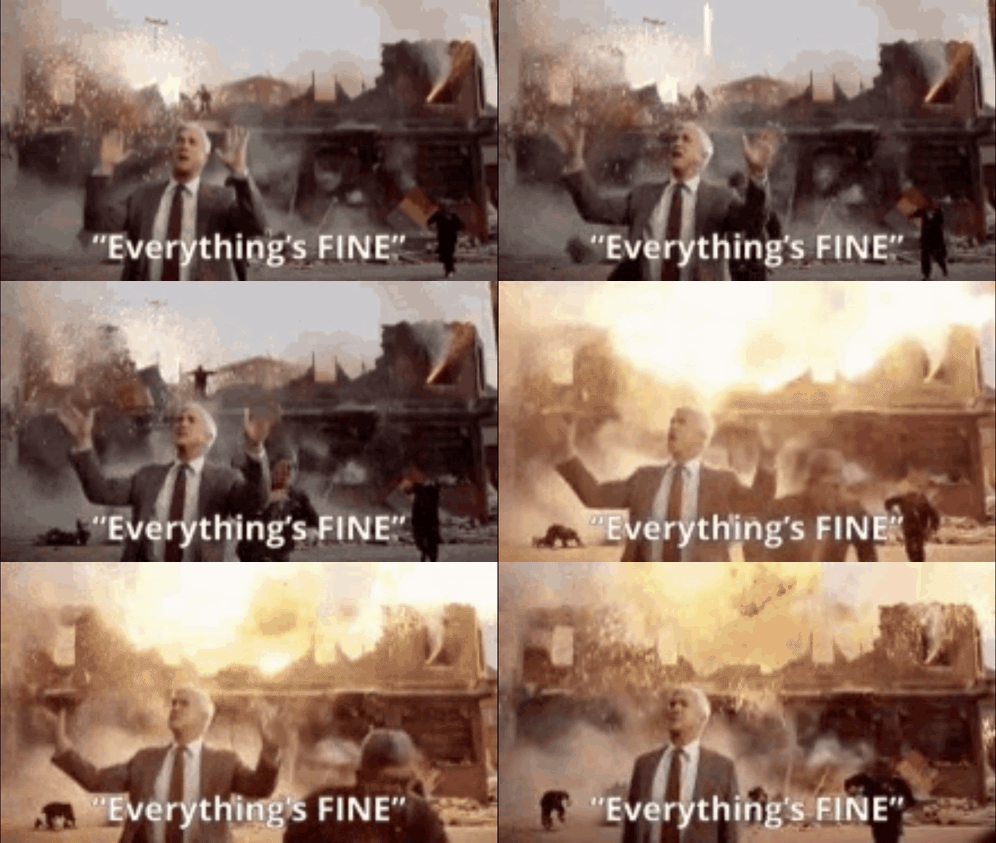
And over here at Substack, one of the nation’s most prominent baseball essayists, Joe Posnanski, reacted to one person’s notion on Twitter that baseball might have an “economic problem” by laying out the kind of money baseball is raking in and insisting that the Dodgers still might not actually win the World Series and by declaring that “Baseball is fine,” which, I mean…
III.
And I don’t mean to pile on Posnanski, because I think I know what he was trying to say here, which is that baseball really should be fine.
