
The Strange Triumph of Rob Deer
How baseball's most unlikely folk hero became the blueprint for the modern hitter.

This is Throwbacks, a newsletter by me, Michael Weinreb, about sports, history, culture, and politics—and how they all bleed together.
If you like what you read, please click the button below, join the mailing list for FREE. And if you’ve been reading for a while, please consider joining the list of paid subscribers to unlock weekly paid posts and allow me to expand Throwbacks’ offerings. And please share it with one or two people you know.
Here is a link to get 20 percent off either a monthly or yearly subscription:
I.
He struck out in Great Falls and Cedar Rapids, he struck out in Fresno and Shreveport, and he struck out in Phoenix. He struck out in Single-A, he struck out in Double-A, and he struck out in Triple-A, over and over again, once or twice nearly every day of the summer, generating enough wind to power the majority of those cities almost entirely on his own. By the time he was 23 years old, a young outfielder named Rob Deer had set minor-league records for four straight seasons, striking out 683 times over the course of 2,124 plate appearances, or roughly 32 percent of the time. Yet Deer kept moving up the ladder in the San Francisco Giants system, because over the course of those four seasons, he accomplished two other things: He hit 126 home runs, and he walked over 300 times.
This being 1987, there was not yet a term to describe Deer’s unique blend of skills. In the minors, the Giants’ hitting instructors kept trying to readjust Deer’s approach and cut down on his strikeouts. Eventually, Frank Robinson, then the manager of the Giants, told them, “Why not leave the kid alone?” What was wrong, Robinson figured, with a guy who hit 30 home runs a year and drove in 100 runs? Why not let Rob Deer be Rob Deer?
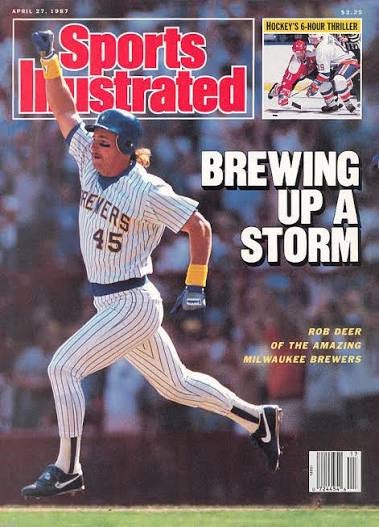
So the Giants promoted Rob Deer to the major leagues, and in his first full season in 1985, he came to the plate 187 times and struck out 71 times. The Giants had seen enough; they traded Deer to Milwaukee, where he found himself an anchor in the lineup of a team that won its first 11 games of the season in 1987. And then, with the Brewers trailing by three runs in the ninth inning of their 12th game and the wind blowing straight in, Rob Deer did this.
II.
Deer hit 33 home runs his first season in Milwaukee in 1986, and hit 28 more in 1987. He would hit at least 20 home runs over the course of the next six seasons, and that was enough to keep him a fixture on Major League rosters, even as his batting average continued to plummet. In 1991 with the Detroit Tigers, Deer hit .179 with 25 home runs, but he also walked 89 times, putting his on-base percentage at .314. A few years later, as the first baseball Usenet message boards popped up, Rob Deer became a folk hero, praised by the pioneering statistical wonks of the Internet for his ability to not actually put the ball in play. It was, at first, a sarcastic method for trolling the sacred precepts of baseball itself; a message-board lurker named Christina Kahrl built an entire Norse mythology around Deer’s abilities to deliver what she called the “Three True Outcomes,” and then, in 2000, a colleague of Kahrl’s at a new website called Baseball Prospectus further popularized the term.
Over the course of the 21st century, something strange happened: The joke evolved into a way of life. Young players and the executives who signed them began to care less about strikeouts and more about on-base percentage and home runs. The rates of each of the Three True Outcomes continued to rise; as pitchers continue to throw the ball harder and harder, those rates now seem destined to perpetuate indefinitely. Three True Outcome players have evolved from a punchline into the unquestioned centerpiece of the sport, and rules changes from the pitch clock to ABS challenges of ball and strike calls have done nothing to stem the tide.
On Monday night, Kyle Schwarber, the apotheosis of the modern TTO era, nearly won the home-run derby in Philadelphia, at the midpoint of a season in which he has hit 32 home runs, walked 59 times, and struck out 144 times, or nearly 35 percent of his at-bats. (The winner of the derby, the Cardinals’ Jordan Walker, has struck out 98 times, or a mere 25 percent of his at-bats.) At this pace, Schwarber will strike out roughly 240 times this season; he is essentially Rob Deer with additional pop and better branding.
Of the 25 players who have hit at least 20 home runs this season, nine have struck out at least 100 times, and six more have struck out at least 90 times. There are now nine players with TTO rates of over 50 percent, and many of them are considered to be some of the best hitters in baseball; the overarching TTO rate in baseball has skipped upward from 33.7 percent last season to 34.2 this year. This is just the way things are now, and we’ve given up on asking if there’s much of anything we can do about it. There is an entire generation of talent who understands that the easiest way to get paid is to hit like Kyle Schwarber: Big, loud, and often empty. And it’s only when you witness one of the game’s endangered species that you begin to wonder what we might have lost along the way.
Which brings me to the singular genius of Luis Arraez.

