
Bagheads (1980)

This is Throwbacks, a newsletter by me, Michael Weinreb, about sports, history, culture and politics. Welcome to all new readers/subscribers, and if you like what you’re reading, please join the mailing list and share, on social media or through e-mail or however you feel comfortable sharing. (It’s still FREE to join the list: Just click “None” on the “subscribe now” page.) The best way you can help out is by spreading the word and sharing with others. That said, I have set up payment tiers, if you wish to chip in something or “leave a tip”—I’ve made them as cheap as Substack will let me make them, which is $5 a month or $30 a year.
I.
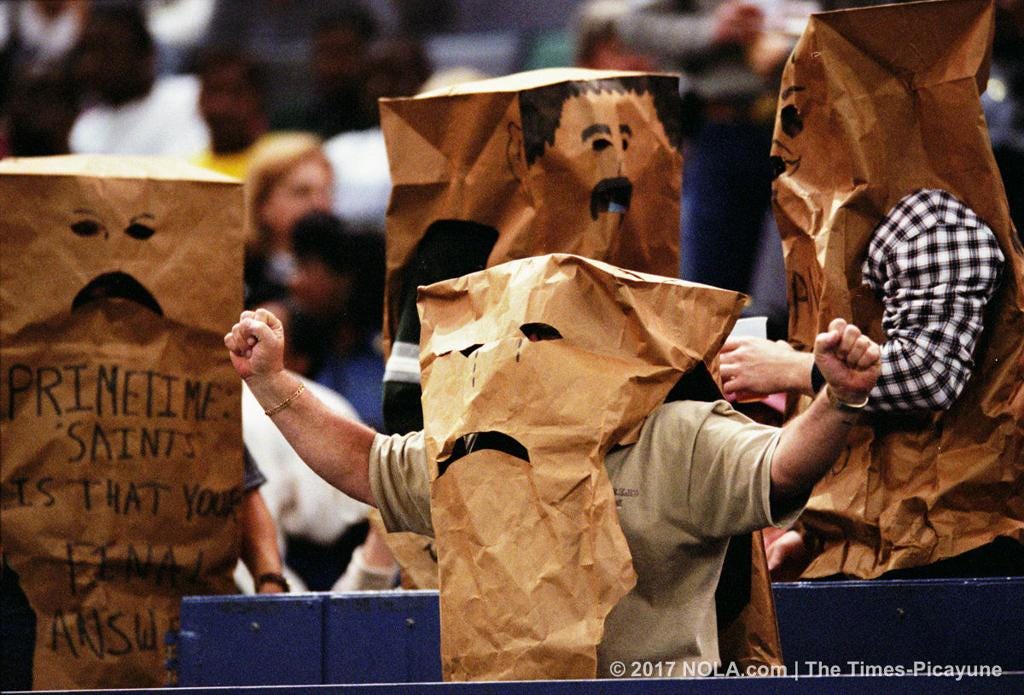
In the fall of 1980, a man walked into a bar wearing a paper bag over his head. His name was Jerry Gogreve, and he was a fan of the New Orleans Saints, a smoldering dumpster fire disguised as a football team. The Saints were 0-7, and would finish that season 1-15; since their inception as a franchise in 1967, the Saints had never had a winning season. Over the course of the next few weeks, Gogreve’s idea—inspired by a bag-wearing comedian named the “Unknown Comic”—got taken up by Bobby LeCompte, a bartender at a place owned by a famous New Orleans sportscaster named Buddy Diliberto, who began wearing a bag over his head while on the air.
And then fans began wearing bags over their heads to games. The Saints, a franchise that had deftly avoided the playoffs every single year, became known as the Aints. The paper bag became the platonic ideal of an embarrassed fan demanding anonymity for an affliction he could not shake. And this is the thing about sports fandom that they don’t tell you when you are young: Once you buy in to that emotional attachment, you are often stuck with what you’ve got. Whether you like it or not.
II.
A few short years after Jerry Gogreve draped his head with a brown paper sack, as the Saints continued to labor through an era of brilliant mediocrity, I developed an affliction that I have written about many times before. It began because my father started taking me to Penn State basketball games. This was partly because he was a New Yorker who happened to enjoy watching basketball; it was partly because there is literally nothing else to do in central Pennsylvania in the dead of winter if you don’t derive pleasure from murdering horned mammals in the woods.
What we did not realize is that Penn State basketball was not anything like actual basketball. It was a Twilight Zone of terror and doom and heartbreak, most of which is covered in this very long chronicle I’ll link here and will spare you from in this newsletter. In 1984, Penn State went 5-22, and even as they began to improve over the course of the decade, they would still lose games in vexing fashion, as when they somehow blew a nine-point lead in the final 83 seconds in a loss to Temple in 1987. And the worst part was that no one really cared, because basketball was just a break between football seasons. Getting upset about these defeats was truly shouting into the void.
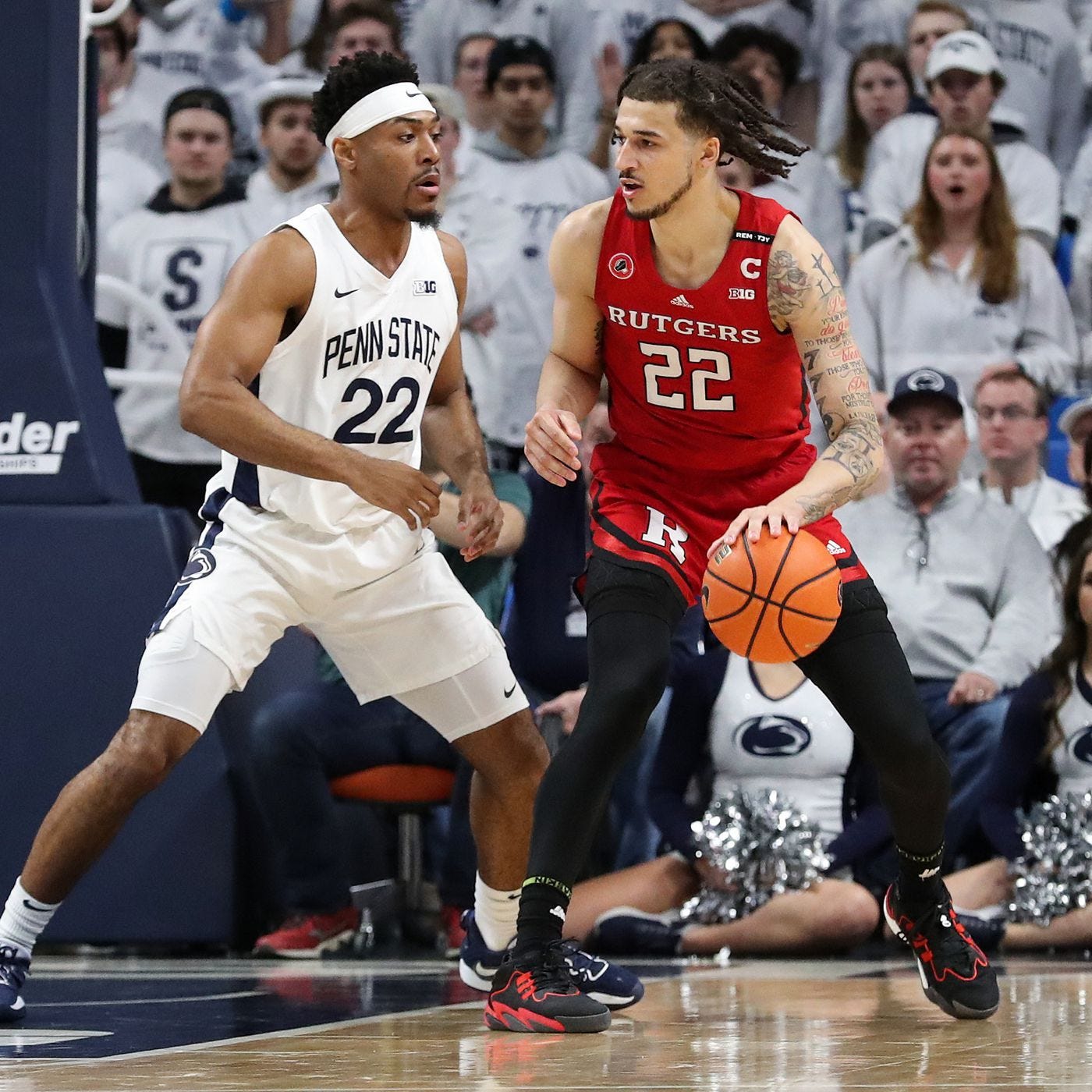
In between all of that, some random note of surprise would occasionally lull you from the doldrums, like an out-of-nowhere upset of UCLA in the NCAA tournament in 1991, or a completely illogical Sweet Sixteen appearance in 2001, or a baffling run through the Big Ten tournament in 2011. But mostly, you learned to expect the worst. You learned to realize that ignominious failure was an inevitable part of life. And when Penn State somehow blew a 17-point lead in a must-win game against Rutgers, when they missed every one of their 14 field-goal attempts in the final nine minutes, when their best shooter missed all 11 of his three-point attempts, you could not help but court that familiar feeling that you were marooned in an interminable hellscape.
On Wednesday evening, with Penn State clinging to a slim hope of playing in the NCAA tournament—buoyed by the best coach they’ve ever had and a star player whose game is lifted straight out of Rucker Park—I literally watched a basketball game through one eye while covering the remainder of my face with my hands. There was no one around—I had warned my girlfriend to stay away—but I still felt like a wildly insecure seventh-grader again. I felt like draping my head in a sack lunch bag. But then something truly bizarre happened, something that I almost wasn’t sure how to react to, because it was actually good:

III.
I’ve written this before, but it’s worth repeating, perhaps as much as a Zen koan to myself as anything else: I do not have children, but if I did, and if they cared about sports, I would deliberately steer them toward at least one failing team, because everyone should be a devoted fan of at least something that repeatedly breaks your soul. There is limited value in witnessing repeated victory over the course of a generation from one’s sports teams, which is why I presume every child who grew up in New England over the course of the past two decades is eventually going to become a narcissistic serial killer (with the exception of perhaps one of my own nephews). It is in failure that one discovers their true self, and sometimes that means hiding away and coming to terms with that failure, until finally you yank off the paper bag and emerge into the light.
In 1987, the New Orleans Saints went 12-3, the first winning season in team history. Bobby LeCompte held a ritual burning of that original Aints paper bag, and a mere 22 years later, the Saints would win the Super Bowl. By then, the Cult of the Baghead had spread to every moribund franchise, and to every fan who felt as if their very allegiance to a team had doomed them to eternal hopelessness. The only thing to do was to carry on, year after year, in the belief that things may be terrible now, but they can only get better. And that is the other wonderful part of being a fan of a terrible team: You continue to believe that someday, against all logic, they actually might.
This newsletter is a perpetual work in progress. Thoughts? Ideas for future editions? Respond to this newsletter, Contact me via twitter or at michaeliweinreb at gmail, or leave a comment below. If you enjoyed this newsletter, please join the list and/or share it with others.
While Kentucky basketball has certainly provided me with many great moments and seasons, being a fan of the football team has certainly countered those emotions. From watching the painfully bad teams of Coach John Ray in the early 70s, to the dangling carrot moments of the LSU Hail Mary game and the 7 OT loss to Arkansas, I can still say I was there. At least the past few seasons under Rich Brooks and Mark Stoops have had there enjoyable moments.