
An African Goalkeeper Is Everything Polymarket Can't Price
Why the World Cup doesn't care what Rick Rubin thinks.

This is Throwbacks, a newsletter by me, Michael Weinreb, about sports, history, culture, and politics—and how they all bleed together.
If you like what you read, please click the button below, join the mailing list for FREE. And if you’ve been reading for a while, please consider joining the list of paid subscribers to unlock weekly paid posts and allow me to expand Throwbacks’ offerings. And please share it with one or two people you know.
I.
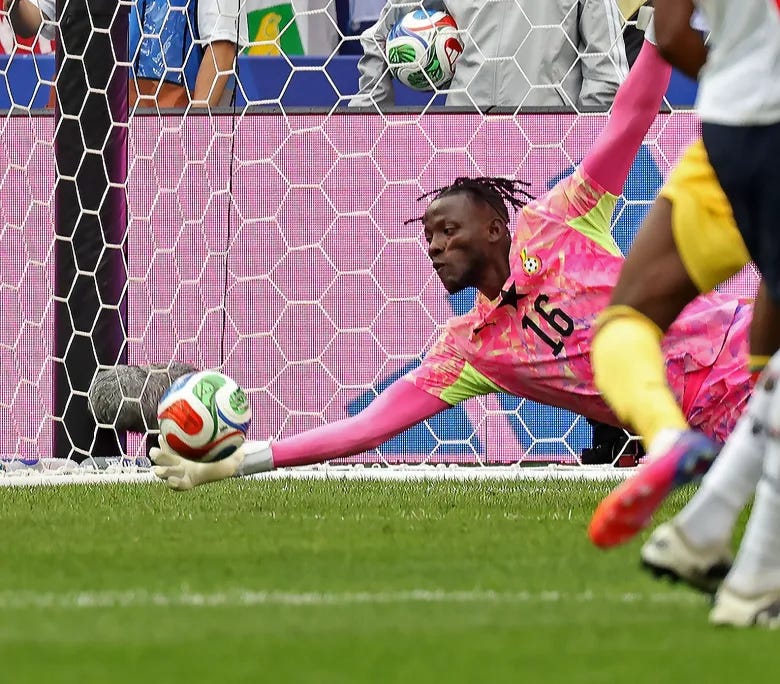
Bear with me for a moment, because I want to begin today by telling you about a 33-year-old goalkeeper from the West African nation of Ghana. Until this week, I cannot say I had spent much of my life thinking about the Ghanaian national soccer team; as a cloistered American, I cannot say I could accurately identify Ghana on a map of Africa until I looked it up. But this is the joy of the World Cup: These stories emerge from completely unexpected and often neglected corners of the world, no matter how much the bureaucrats and oligarchs try to bend the forces of nature to their will.
On Tuesday in Foxborough, Massachusetts, Ghana faced England, and their goalkeeper was Benjamin Asare, a backup who had been forced into action after Ghana’s starting goalie suffered a groin injury before halftime of Ghana’s match against Panama. Asare didn’t make the national team until last year, when he was 32. Along the way, he played soccer part-time and worked odd jobs as a mason, a steel bender, a carpenter, and a bus conductor. At one point, he missed 18 months with an ankle injury and considered quitting. He didn’t quit, and he got promoted to the national team, and he stepped into the Panama game and didn’t allow a goal in the second half. And then against England, this happened:
That is a highlight reel of Asare making save after save and flustering some of the best soccer players in the world, including Arsenal star Bukayo Saka and former Tottenham Hotspur legend Harry Kane. Ghana wound up drawing England, 0-0, and as I write this, they are on the verge of advancing to the knockout stage as one of the 32 best teams in the world, thanks in large part to one of the unlikeliest star goalkeepers in World Cup history. Asare was raised by his grandmother after his mother died when he was young; when some local reporters went to interview his grandmother after the game, she broke down into tears. And I kind of hate to chase the emotional purity of that moment by swerving head on into the hellscape of modern life, but again, bear with me, because I think the contrast is pretty remarkable.
II.
What you see above is a commercial for a website called Polymarket, which first appeared during a Hydration Break at the World Cup. This is a fitting pairing of advertiser and time slot, because one might argue they are both signifiers of the moral bankruptcy of our current cultural moment.

Polymarket is what’s known as a “prediction market,” which is basically a conduit to wager on anything imaginable (though much of its traffic comes from wagering on sports). It was founded by a slick talking twenty-something who apparently walks the streets of New York dressed like Cosmo Kramer, and who operates by utilizing a quasi-legal loophole that allows Polymarket to exist because its users are betting against each other rather than betting against some impenetrable House. Polymarket and its rival Kalshi are incredibly popular, so much so that even Mark Zuckerberg has decided to do the one thing he does best, which is to steal other people’s ideas.
Prediction markets have found a target audience with young people, most of whom have grown up in a world that has taught them that the only way to work the system to your advantage is to exploit others in the process. But the major problem with prediction markets like Polymarket is that no one likes them. And when I say no one, I mean no one. According to a New York Times Magazine story by Adam Iscoe, only four percent of Americans, and seven percent of young men, thought prediction markets were good for society.
Those are remarkably terrible numbers, and that brings me to the ad you see above, a one minute, 15 second series of questions accompanied by stylized imagery that attempts to seize on the World Cup in order to sportswash Polymarket as some kind of spiritual enterprise founded for the betterment of humanity by allowing us to come closer to answering the unanswerable questions of human existence. This is why the ad is anchored by the yogi-esque presence of Rick Rubin, the white-bearded weirdo who admittedly produced a litany of great albums as well as Andrew Dice Clay’s Dice Rules, and has now repositioned himself as some kind of postmodern Dalai Lama by way of Blood Sugar Sex Magik. The ad is soundtracked by a song written by Kanye West, a man who has repeatedly flirted with Nazism, but whatever, bygones and such.
And I know, at some level, that this ad is meant to provoke a furious reaction; I know that Polymarket is betting on the notion that all publicity is good publicity. I also know that there may actually be some inherent societal value to prediction markets, in the way that they harness the wisdom of crowds in order to address thorny questions. But we all know that’s not what’s happening here; we all know that Polymarket is not going to pivot to becoming a purely philanthropic enterprise. We all know that insiders are gaming Polymarket’s system, and that Polymarket itself is gaming its own system by making it look easier to win than it actually is.
The ethics of prediction markets are questionable in large part because they are built on a foundation of inequities, writes ethics expert Don Heider. They rely on “the views of people who are already educated, already wealthy, and already connected,” Heider writes. That inverts the central idea that access to information shouldn’t be based on wealth, which is why public libraries were invented in the first place. And beyond that, they often trade on the pain and suffering of others.
“Imagine,” Heider writes, “being a citizen of a country whose stability is somebody else's investment opportunity.”
III.
It was impossible not to notice the contrast, and not to notice the juxtaposition of a story like that of Benjamin Asare with the crass provocation of that Polymarket advertisement. There is a shot toward the end of the Polymarket ad which poses the question, Do You Believe in Anything?, and this was the thing that put me over the edge, because in a lot of ways, you can argue Polymarket is explicitly trafficking in nihilism. The way they predicate their entire business model on somehow getting an edge on others, on being able to predict the future more accurately than those with less access than you, is the polar opposite of the spirituality they purport to align themselves with. The entire purpose of meditation is to live in the moment and to connect with humanity; it is not about attempting to manipulate the future and exploit the naivete of others in the process. And yet here we are, watching Rick Rubin debase himself to the opening notes of a song in which Kanye urges us, ironically enough, to run away as fast as we can.
The best element of the World Cup—the best element of sports in general—is that things happen when we don’t expect them to happen. Polymarket’s entire premise is that you can traffic on insider knowledge in order to circumvent this feeling altogether. But that’s not the point of any of this; that’s not the point of spirituality, and it’s not the point of life. I don’t know if you could place a bet on Polymarket that a 33-year-old backup Ghanaian goalkeeper would shut out one of the most talented teams in the world over the course of 90 minutes, and I don’t really care if you could. I saw it happen in real time.
This newsletter is a perpetual work in progress. Thoughts? Ideas for future editions? Respond to this newsletter, Contact me via twitter or at michaeliweinreb at gmail, or leave a comment below. If you enjoyed this newsletter, please join the list, consider becoming a paid subscriber, and/or share it with one or two people you know.
This is great. No notes. I’m glad I subscribe.
Great take! Love this.