
America Loves Soccer Now. So Why Does the World Cup Feel So Empty?
The sport finally found a home here. It just never belonged to us.

This is Throwbacks, a newsletter by me, Michael Weinreb, about sports, history, culture, and politics—and how they all bleed together.
If you like what you read, please click the button below, join the mailing list for FREE. And if you’ve been reading for a while, please consider joining the list of paid subscribers to unlock weekly paid posts and allow me to expand Throwbacks’ offerings. And please share it with one or two people you know.
I.
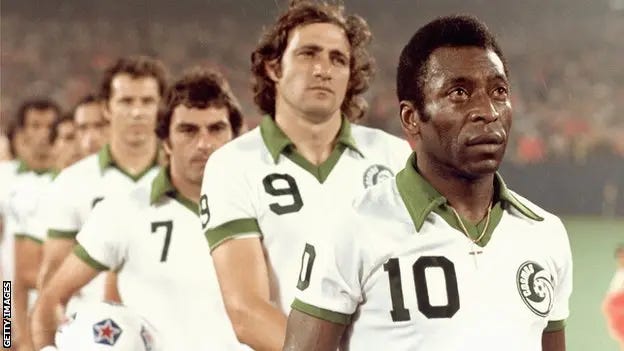
What I remember is not the men who played soccer. What I remember are the names of the men who played soccer. Here were these dudes gliding across the television screen with mellifluous names that would remain lodged in my brain for my entire life: Giorgio Chinaglia. Franz Beckenbauer. Carlos Alberto. Johan Neeskens. For a brief period in New York City, at a moment when I was too young to remember much of anything except the way those names sounded, these men were members of a professional soccer team called the Cosmos. They were not American, but they had come here to embrace the American dream, to win games and to get fabulously rich and famous and to briefly play alongside a Brazilian named Pele, who at that moment (and arguably even now) was the best soccer player who had ever lived.
The Cosmos, a moribund franchise in a flailing American soccer league, somehow lured Pele to New York City in 1975 with a larded contract and the promise that he could singlehandedly transform soccer into a major sport in America. Pele played his first game with the Cosmos at a crumbling stadium on New York’s Randall’s Island, on a pitch so completely devoid of grass that they’d spray-painted the whole thing green in order to make it look better for the CBS cameras covering the game. (When he saw his legs coated in green paint, Pele worried that perhaps he’d attracted some kind of exotic fungus.)
Soon, the Cosmos moved to New Jersey and began playing the Meadowlands. They drew 77,000 fans for home games. They became rock stars who shimmied in front of rock stars like Mick Jagger. For a brief time in New York, even after Pele’s departure in 1977, the Cosmos were a phenomenon, a conflagration of international talent who partied at Studio 54 and peacocked their way to North American Soccer League championships and briefly charmed a city into believing in the promise of soccer. Fifty years later, the Cosmos remain arguably the most charismatic soccer team ever to play their home games on American soil, largely because their stars came from elsewhere to prove their worth to a skeptical country. They are a reminder that America’s relationship with soccer, even now, is driven not from the inside, but from our inherent connection to the outside world.
II.
It’s a fun parlor game to dig back into the clippings from the 1994 World Cup and unearth headlines like this one:
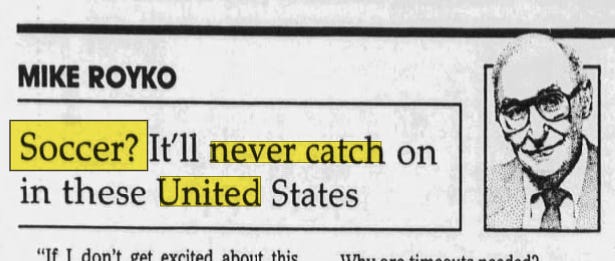
It wasn’t just famously cranky Chicago columnists spewing that kind of vitriol. You could find replications of that column in newspapers all across the country, from Detroit to Louisville to Los Angeles. Much of the default attitude was xenophobia: The World Cup was a novelty that would change nothing, and a new American soccer league scheduled to debut the following season would soon go the way of the New York Cosmos, because there was no room for soccer in America. Soccer was not ours, the reasoning went, and we did not play well enough with others to make it work. If we were not the best at something, why would we bother to engage with it at all? (“Soccer,” one writer said in the 1970s, “was just a game played by Commies and fairies in short pants.”)
Thirty-two years later, as America prepares to host the World Cup once again, soccer in America is now at least as popular—if not more popular—than baseball. And yet soccer’s place in America remains entirely unique, largely because we’re still kind of bad at it around here.
III.
A decade ago, as a kind of personal growth experiment, I joined a fantasy Premier League group with a handful of genial dudes who were far more passionate about soccer than I was. Over time, I began to process the rhythms: The promotion and the relegation, the sheer financial force of Manchester City and the shocking rise of Leicester and the inevitable heartbreak of Arsenal. There’s a cultural shorthand to soccer that I’m just beginning to apprehend, but that shorthand has become so popular that it’s turned clever British podcasters into American media moguls. The English Premier League has become my Rosetta stone, my way of processing the reasons why soccer matters in the first place.
And over the course of that entire decade, I have never had a single conversation with the folks in my fantasy league about American soccer.
I know there are pockets of America where Major League Soccer kind of means something. (I lived briefly in Portland, where professional soccer is arguably more popular than professional basketball.) But for the most part, America’s passion for soccer has very little to do with America itself. MLS, for all its success, is a place where European stars retreat into semi-retirement. The best American players are still generally viewed as marginal talents abroad.
And this is the strange contradiction of the 2026 World Cup: It returns to the United States at a moment when the sport is wildly more popular than it was three decades ago. But that popularity is driven almost entirely by the quality of the product outside of the United States.
IV.
In a country that tends to wallow in its own cultural ego—a country that actually stole the name of the world’s sport and transformed it into its own violent pastime—soccer is the one place where the culture thrives outside of America’s own self-conception. And I think this is why this World Cup feels so utterly devoid of meaning: Because it is an event premised on our connection to the outside world that arrives at a moment when America has managed to so thoroughly alienate the outside world.
How do you reconcile those things? How can you enjoy a tournament that’s dependent on interdependence while the host country retreats into abrasive isolationalism? I’m not sure if you can. And that might make for an awkward few weeks.
Fifty years ago, the New York Cosmos briefly imported the rest of the world to New York City. By 1985, the North American Soccer League was dead, and the players had gone back to Europe, and America had retreated into its obsession with the bruising rhythms of its own brand of football. Now the world is coming back here, to a country that’s more attuned to soccer than ever—and is also in the midst of wrestling with the limits of its own ego. Here comes this thing we’ve grown to love, and yet it doesn’t belong to us at all.
This newsletter is a perpetual work in progress. Thoughts? Ideas for future editions? Respond to this newsletter, Contact me via twitter or at michaeliweinreb at gmail, or leave a comment below. If you enjoyed this newsletter, please join the list, consider becoming a paid subscriber, and/or share it with one or two people you know.
You make some very valuable points on the intersection of current politics and soccer's role in Americans' sports fandom. I recall "discovering" soccer about 15 years ago and realizing what a global phenomenon it is. In my cross-sports "GOAT" analytics model, I give greater weight to soccer than to any other sport for just this reason.
Profoundly accurate assessment. I feel we should be embarrassed as a country to be called a "host" of an event we have no business today deserving.